How to Remember the Formulas of Cardiac Glycosides
the rich get richer.
(this also applies to knowledge)
To start studying the formulas of cardio steroids, recall the formula of cyclopentanoperhydrophenanthrene (see saponins), but this time we will draw the cyclopentane ring as a triangular protrusion downwards.
All cardanolides and bufadienolides contain in positions at C10 and C13 atoms a CH3 group, which, as we have already agreed, we denote with dashes.
All aglycones of cardiac glycosides (= genins) contain a –OH group at position C3, which is where sugar residues are attached during the formation of glycosides.
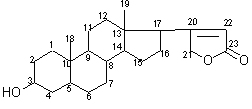
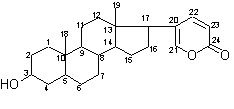
Cardanolide Bufadienolide
The sugars of cardiac glycosides are quite specific – instead of the typical –CH2OH group found in sugars with six carbon atoms (hexoses), they contain a –CH3 group (that is, it lacks oxygen) – and therefore are called 6–deoxysugars (I remind you that in the –CH2OH group of hexoses, the carbon atom is numbered 6).
The overwhelming majority of deoxysugars that you need to know, in addition to the absence of oxygen in the –CH2OH group, also do not contain it at the C2 atom (digitoxose, cimarose, oleandrose) and therefore are 2,6–deoxysugars. The exception is rhamnose (6–deoxysugar – oxygen is absent only in the –CH2OH group).

Now we can start memorizing the basic formulas of cardanolides.
Let’s start with the cardiac glycosides of purple foxglove (Digitalis purpurea).
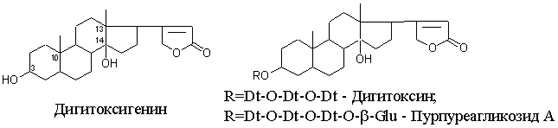
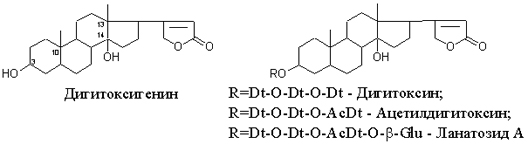
Since you already know that the aglycone part of cardiac glycosides is otherwise called genin, and we have moved on to the glycosides of foxglove (lat. – digitalis), the first aglycone on which we build cardiac glycosides will be called digitoxigenin. It contains, in addition to the structure of cyclopentanoperhydrophenanthrene you already know, two –CH3 groups and one –OH group, and also contains (by the way, like all other cardiac glycosides you need to know) another –OH group – at the opposite end from –CH3 at C13, that is, at position C14.
If three molecules of digitoxose are attached to the –OH group at C3, we obtain digitoxin, and if one more molecule of beta–glucose is added, then we get – purpureaglycoside A (all purpureaglycosides are from Digitalis purpurea).
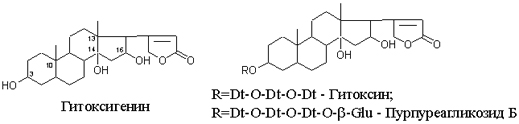
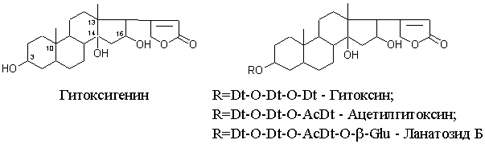
Now, if we attach another –OH group to the molecule of digitoxigenin (at position C16), we obtain gitoxigenin. Similarly, we construct the glycosides of gitoxigenin – gitoxin and purpureaglycoside B.
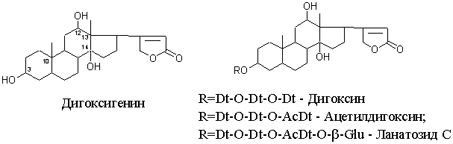
And if we add an –OH group at C12 to the molecule of digitoxigenin, we will obtain digoxigenin, on the basis of which we construct digoxin and purpureaglycoside C.
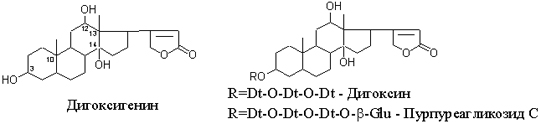
Next, we will consider the cardiac glycosides of woolly foxglove (Digitalis lanata).
If you have already learned to construct cardiac glycosides of purple foxglove, then the subsequent construction will not be difficult for you.
Cardanolides of woolly foxglove are also constructed on the basis of digitoxigenin, gitoxigenin, and digoxigenin. But when obtaining typical glycosides of woolly foxglove, instead of three molecules of digitoxose, we add two molecules of digitoxose and one – acetildigitoxose to the corresponding aglycone.
Thus, we obtain acetildigitoxin based on digitoxigenin, acetilgitoxin based on gitoxigenin, and acetildigoxin based on digoxigenin.
And, ultimately, if we add one molecule of beta–glucose to acetildigitoxin (as we did when obtaining purpureaglycosides), we will get lanatoside A (remember – these are cardanolides of Digitalis lanata); in the case of acetilgitoxin – lanatoside B; for acetildigoxin – lanatoside C.
You see, it’s not difficult!
Besides foxglove, cardiac glycosides are also found in other plants, in particular, in strophanthus, lily of the valley, adonis, and yellow rocket.
Cardiac glycosides of Strophanthus kombe are constructed on the basis of an aglycone called K-strophanthidin (K, that is, kombe). It differs from digitoxigenin in that in its molecule, instead of the –CH3 group at position C10, there is an aldehyde group –CHO and another –OH group appears – at position C5 (at the opposite end from the aldehyde).
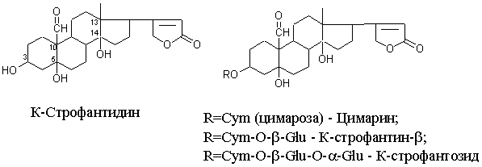
Based on K-strophanthidin, we construct its glycosides – cimarine (we attach one molecule of cimarose instead of hydrogen at position C3); K-strophanthin-beta (we add one molecule of beta-glucose to cimarose) and K-strophanthoside (we add another molecule of alpha-glucose to cimarose and beta-glucose).
And if we attach a molecule of rhamnose instead of cimarose to the molecule of K-strophanthidin, we obtain the cardanolide of lily of the valley (Convallaria majalis) – convallatoxin.
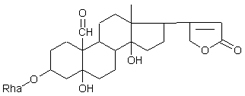
Convallatoxin
Let’s continue. In the molecule of convallatoxin, we replace rhamnose with digitoxose and obtain the main cardanolide of gray mustard (Erysimum canescens) – erizimin.
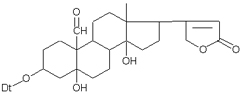
Erizimin
And, finally, we add an –OH group at C16 to the molecule of convallatoxin (as in gitoxigenin, remember!). The resulting compound, which is also a rhamnoside (contains a rhamnose residue at C3 of the aglycone), is called adonitoxin, and is the main cardiac glycoside of Adonis, that is, spring adonis (Adonis vernalis).
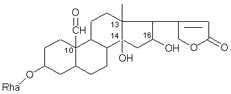
Adonitoxin
Among bufadienolides, you should remember one glycoside that was previously used as a medicinal preparation – coreliborin. It has now been discontinued due to insufficient effectiveness and lack of raw materials (it is found in the rhizomes with roots of some species of hellebore – Helleborus sp., family Ranunculaceae – black hellebore, reddish hellebore, Caucasian hellebore, etc.).
This cardiac glycoside is very similar in structure to convallatoxin, except that its lactone ring is not 5-membered like that of convallatoxin, but 6-membered, doubly unsaturated, which is characteristic of all bufadienolides.
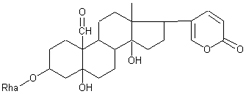
Coreliborin
If you have successfully mastered all these formulas, – congratulations! You have made a significant step in studying pharmacognosy. I hope the subsequent steps will be easy and effortless for you.
You just need to have patience to absorb the vast amount of information that consists of phenols, lignans, xanthones, coumarins, chromones, flavonoids, tannins, vitamins, alkaloids, and thioglycosides. Let’s move on!