How to Remember the Formulas of Simple Phenols
it is not worth boasting about victories!
How to remember the formulas of simple phenols and their derivatives?
Phenol is a benzene ring with one –OH group.
If there are two –OH groups in the molecule (dihydroxyphenols), they can be located next to each other (ortho-position, remember as “near”) – pyrocatechin; one carbon atom apart (meta-position, remember as “between”) – resorcin; and two carbon atoms apart, or opposite each other (para-position, remember as “opposite”) – hydroquinone.
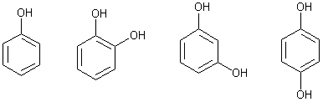
Phenol Pyrocatechin Resorcin Hydroquinone
Trihydroxyphenols (with three –OH groups) are formed by the arrangement of the –OH groups in ortho- or meta-positions. Three –OH groups next to each other is pyrogallol (also pyro-, like pyrocatechin, which has 2 –OH groups next to each other); three –OH groups located one carbon atom apart is phloroglucin.
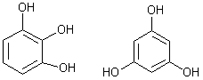
Pyrogallol Phloroglucin
From the glycosides of simple phenols, you need to know three glycosides – derivatives of hydroquinone.
Arbutin is formed by the addition of one glucose residue instead of a hydrogen atom in one of the –OH groups. In methylarbutin, the second –OH group undergoes methylation. Both glycosides are found in bearberry, cranberry, and blueberry. They have diuretic and antiseptic effects.
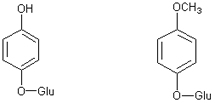
Arbutin Methylarbutin
(beta–D–glucoside (beta–D–glucoside
of hydroquinone) methylhydroquinone)
Salidroside is one of the main glycosides of Rhodiola rosea, responsible for the manifestation of adaptogenic action. Its structure is somewhat similar to methylarbutin, but there are two –CH2 groups located before the oxygen atom to which the glucose residue is attached.
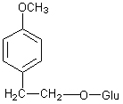
Salidroside
You should also memorize the formulas of the main phenolic acids and hydroxycinnamic acids, which you will need when studying the topic “Tannins”.
As the name suggests, phenolic acids are formed by the addition of a carboxyl (–COOH) group to the phenol molecules. This group can also be attached in ortho-, meta-, and para-positions.
The addition of a –COOH group to the phenol molecule in the para-position forms p-hydroxybenzoic acid, in the ortho-position – o-hydroxybenzoic (salicylic) acid. We will also be interested in their most important derivatives.


p-Hydroxybenzoic acid o-Hydroxybenzoic acid
(= Salicylic acid)
If the –COOH group is added to the pyrocatechin molecule in the ortho-position (that is, near), o-pyrocatechuic acid is formed. If this group is located one carbon atom apart from the terminal –OH group of pyrocatechin (that is, in the meta-position to this group and in the para-position to the second –OH group), we have protocatechuic acid.

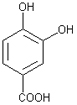
o-Pyrocatechuic acid Protocatechuic acid
In the molecule of gallic acid, there are three –OH groups, and the –COOH group is located opposite the middle one, forming a sort of diagonal.
In syringic acid, this diagonal remains intact, while the edge –OH groups are methylated. If one of the methylated groups is absent, this compound is called vanillic acid (remember “sleepy” vanillin – the aldehyde of vanillic acid, see essential oils).

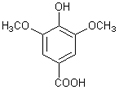

Gallic acid Syringic acid Vanillic acid
Hydroxycinnamic acids are similarly constructed, but they are based on the molecule of p-coumaric acid (p-coumaric). Its structure is similar to that of p-hydroxybenzoic acid, but after the benzene ring and before the –COOH group, there are two –CH= groups connected by a double bond (derivatives of phenylpropanoids).
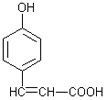
p-Coumaric acid
Just as p-coumaric acid is similar to p-hydroxybenzoic acid, caffeic acid is similar to protocatechuic acid, ferulic acid to vanillic acid, and sinapic acid to syringic acid.
To remember this, we will use such mnemonic techniques. For the first pair of acids (caffeic – protocatechuic), remember the phrase “About this, about that, Kate wants to tell over a cup of coffee”.
The second pair of acids can be associated with the phrase “Sphere of streets – Vanin’s house”.
The first two letters of the word syringa coincide with the name sinapic. Thus, sinapic acid is similar to syringic acid.
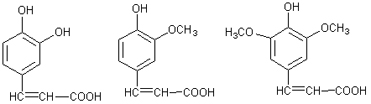
Caffeic acid Ferulic acid Sinapic acid