How to Remember Flavonoid Formulas
it’s time to train!
How to remember the formulas of flavonoids?
This is a structure of the type C6C3(with a heteroatom O)–C6, and opposite the heteroatom in flavonoids, a keto group is often located (except for flavan and its derivatives, where the C3 ring is fully saturated, and even here there is an exception – flavanones, which have a keto group). This most typical structure is characteristic of flavones and isoflavones, which differ from each other by the position of the side benzene ring attachment, which in flavones is attached at position 2 of the heterocyclic ring, while in isoflavones – at position 3 (the suffix “-one” indicates the presence of a keto group).
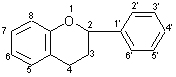
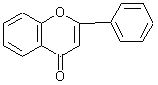
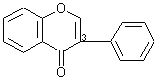
Flavan Flavon Isoflavon
Derivatives of flavones with –OH group at position 3 are called flavonols (which is not surprising, given their alcoholic nature), while the corresponding derivatives of flavan are flavan–3–ols (= catechins).
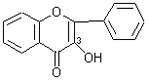
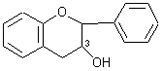
Flavonol Flavan–3–ol (= Catechin)
Compounds that have a structure completely analogous to catechins, but the heteroatom of oxygen carries a positive charge (the oxygen essentially becomes trivalent), and the C3 ring is doubly unsaturated (2 double bonds), are called anthocyanidins.
If the flavan molecules have two –OH groups (at positions 3 and 4), they belong to leucoanthocyanidins (otherwise known as flavan-3,4-diols).
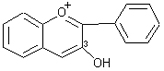
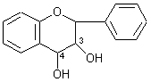
Anthocyanidin Flavan–3,4–diol
(= Leucoanthocyanidin)
The main anthocyanidins include pelargonidin, cyanidin, and delphinidin. All of them contain 3 –OH groups in the C6C3 part – at positions 3, 5, and 7 (easy to remember, through 1) and differ only in the number of –OH groups in the side benzene ring (that is, in the phenyl radical).
Pelargonidin contains one –OH group in the phenyl radical; cyanidin – two; delphinidin – three.

Pelargonidin Cyanidin Delphinidin
To remember this, we can use two mnemonic phrases. Dolphin – is the most developed animal; delphinidin – is the most complex compound among these three. And later just memorize this nonsense: the dolphin was pelargonized with cyanidin.
Usually, such phrases are the easiest to remember… More than 30 years have passed since I read “Alice in Wonderland” by Lewis Carroll, and I still remember only one excerpt from it:
It barked.
The hlivkie shorki piryalis po nave
And hryukotali zelyuki
Like myumziki in move.
I hope this will not be the only thing you take away from the course of pharmacognosy…
A chemical characterization similar to delphinidin, cyanidin, and pelargonidin can be given to three compounds based on flavonol (kaempferol, quercetin, myricetin). They also contain 3 –OH groups in the C6C3 part – at positions 3, 5, and 7 and differ only in the number of –OH groups in the phenyl radical (ring B). Kaempferol has one –OH group; quercetin – two; myricetin – three.

Kaempferol Quercetin Myricetin
In this series, myricetin is also last alphabetically (3 –OH groups). Regarding the other two compounds, remember that kaempferol comes first (kaempferol has one –OH group in ring B and ends with –ol; not –diol, which would be characteristic for two groups, not –triol – for three, but specifically –ol, which is characteristic for one –OH group).
Flavonol glycosides are most often formed at position 3. You need to know the two most important flavonol glycosides, whose aglycone is quercetin. These are hyperoside – a galactoside of quercetin – and the diglycoside rutin – a rhamnoglucoside of quercetin.

Hyperoside Rutin
Chalcones – are flavones with an opened heterocycle, that is, instead of a heteroatom, they have an –OH group.
Flavonoids built on the type C6C2(with a heteroatom O)=CH–C6 (the ring with a heteroatom is pentacyclic, and opposite the heteroatom – a keto group), are called aurones.
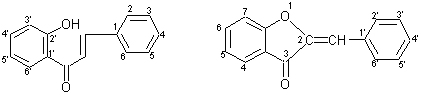
Chalcone Aurone