How to memorize the formulas of thioglycosides

Rule sixteen –
     let’s start competing!

           How to remember the formulas of thioglycosides?

   You have one last section of pharmacognosy to consider, and it is not the most difficult one. Gather yourself – the finale is near!
    Thioglycosides – compounds that contain sulfur – are a complex of substances from the mustard plant Brassica juncea Czern., black mustard Brassica nigra (L.) Koch., and some other plants from the Brassicaceae family.
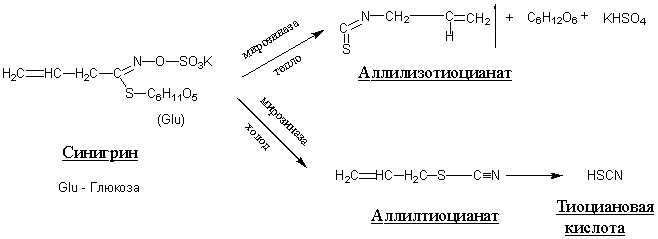
  Sinigrin is a thioglycoside of mustard that, under the action of the enzyme myrosinase, decomposes into allyl thiocyanate or allyl isothiocyanate depending on external conditions.
  You can easily remember the formula of sinigrin if you learn that at the beginning of the molecule it has 3 carbon atoms, which are only bonded to hydrogen, followed by a carbon from which branches extend: the upper branch: =N–O–SO3K (read in Russian – “nosok”), and the lower one: –S–C6H11O5 (Glu = glucose, meaning sinigrin is a glycoside).
tioglikozidy

In an aqueous environment at a temperature of 50–60оC, the enzyme myrosinase, which specifically cleaves sinigrin, converts it into allyl isothiocyanate, the formula of which starts with S=C=N–. This is a volatile component of mustard essential oil. It is allyl isothiocyanate that penetrates through the pores into our body when we use mustard plasters, and it is this compound that exerts antibiotic action.
  When stored in the cold, myrosinase cleaves sinigrin into allyl thiocyanate (did you guess that this is an isomer of allyl isothiocyanate?), which has the same molecular formula as allyl isothiocyanate but differs from it in the position of the S=C=N– group. In allyl thiocyanate, –S–C=N completes the formula. Allyl thiocyanate is a non-volatile component and cannot easily penetrate through human skin pores.

  What should we take away from all of the above? The action of mustard plasters is due to allyl isothiocyanate and some other isothiocyanates. When stored, sinigrin, which is the source of allyl isothiocyanate, decomposes into allyl thiocyanate, which does not exert the necessary antibiotic action, so it is important to consider the shelf life of mustard plasters when using them.

Similar Posts

  • Dill

    DILL Dill greens are characterized by a significant content of vitamin C (ascorbic acid) (132.1% of the Daily Value (DV) per 100 g), beta-carotene (112.8% respectively), vitamin K (phylloquinone) (52.3%), folic acid (37.5%), vitamin B2 (riboflavin) (15.0%), alpha-tocopherol (11.3%), lutein and its isomer zeaxanthin (10.1%), and vitamin B6 (pyridoxine) (9.5%). The following mineral elements predominate:…

  • Contact Information

    Contact Information Konovalova Olena Yuriyivna Head of the Department of Pharmaceutical and Biological Chemistry, Pharmacognosy Kyiv Medical University Kyiv, Ukraine I have deliberately chosen not to provide my email address at this time; due to a heavy workload, I am unfortunately unable to respond to individual inquiries at present. When engaging with this resource, please…

  • Dried Apricots

    DRIED APRICOTS       Kuraga is one of two types of dried apricots, namely dried apricots with the pits removed beforehand. The second type of dried apricots is uruk – apricots (usually small-fruited sweet varieties) dried with the pits, most often simply on the tree in the sun (after drying, they are shaken off)….

  • Viburnum

    VIBURNUM (fruit)         Viburnum berries (Viburnum opulus) possess a high concentration of vitamins, specifically ascorbic acid (119.0% of the Daily Value [DV] per 100 g), vitamin K (phylloquinone) (83.0%), beta-carotene (38.0%), and vitamin E (alpha-tocopherol) (13.0%). The mineral profile is characterized by a significant concentration of macro-, micro-, and ultramicroelements: boron (457.0%…

  • Theses Abstracts

    Theses Abstracts 1. Makovetska O.Yu. Biologically active substances of the genus Hypericum L. as a source for the creation of medicinal products with specified properties. – Abstract of the dissertation … Dr. of Pharm. Sciences: 15.00.02. – Kyiv, 2002. – 37 p. 2. Makovetskaya E.Yu. Biological features and comparative assessment of biologically active substances of…