Maksutina N.P.
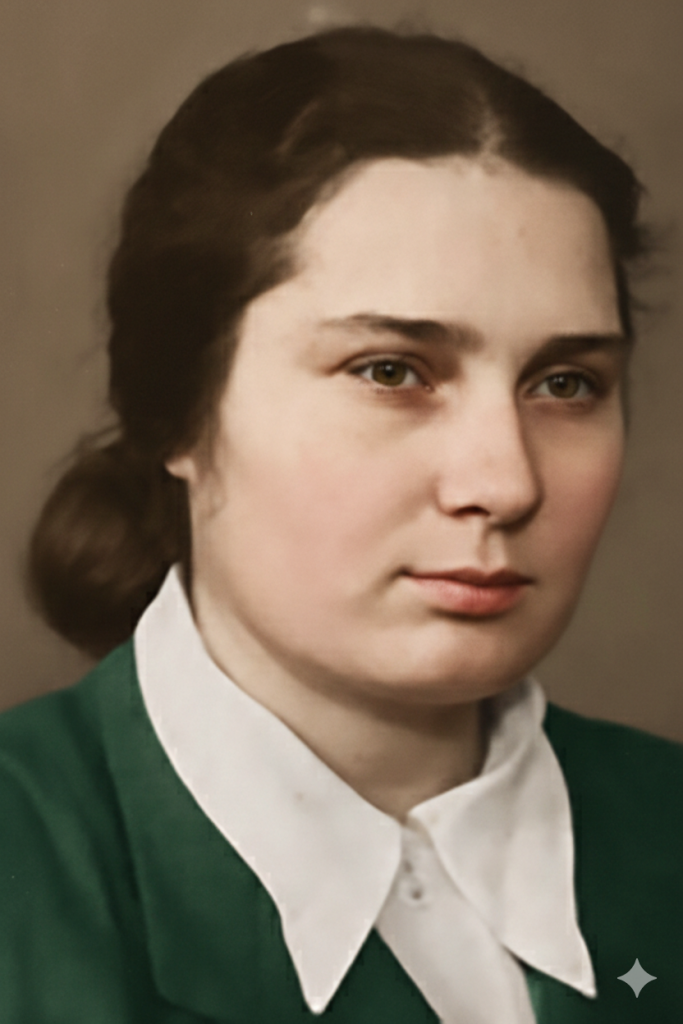 Photo of Maksutina N.P., which she really liked (circa 1956)
 Somewhere in this way, the extraction of biologically active substances from plants was carried out (simulated by AI)
 Maksutina N.P. – one of the pioneers of paper chromatography in Ukraine
(19.02.1925–17.11.2015). 90 years
The text was written directly by Nina Pavlovna and is presented on the page without edits
A participant in the Great Patriotic War.
Born on February 19, 1925, in the village of Nikitovka, Nikitovsky District, Belgorod Region, in a peasant family. Nina Pavlovna’s father and older brother died during the war, so she had to rely solely on her own strength in life. In 1944, after graduating with honors from high school, she entered the Kharkiv Pharmaceutical Institute without exams, which she successfully completed in 1948.
In 1954, N.P. Maksutina was one of the first among the graduates of the Kharkiv Pharmaceutical Institute to defend her candidate dissertation on Syrenia angustifolia (Ehrh.) Rchb. (синоніми: Syrenia cana, Erysimum canum), obtaining the degree of Candidate of Pharmaceutical Sciences. At that time, she was promoted to the position of senior researcher in the laboratory.
It was in the phytochemistry laboratory of KRCPI in the 1950s that N.P. Maksutina mastered methods of phytochemical research of medicinal plants, isolation and determination of the chemical structure of cardenolides, oxycinnamic acids, coumarins and furocoumarins, plant antioxidants, flavonoids, polyphenols, and polysaccharides. This was facilitated by the relatively good equipment of the phytochemistry laboratory of KRCPI (the staff of which was increased to 50 people) not only with equipment and medicinal raw materials but also with analytical, pharmacological, technological laboratories, and even a pilot plant for the implementation of scientific developments.
Each department of the phytochemistry laboratory prepared its candidates for the degree of Candidate of Pharmaceutical Sciences in alkaloids, spasmolytic agents, cardiac glycosides, and phenolic compounds based on plant materials and their implementation in industrial production.
N.P. Maksutina chose phytochemical, chromatographic, analytical, and resource studies of plants from four families – crucifers, St. John’s wort, legumes, and umbellifers – as the main direction of her research, aiming to identify sources of raw materials with a high content of active substances suitable for industrial production.
To carry out this labor-intensive work, N.P. Maksutina developed a new express chromatographic method that allowed for the rapid examination of more than 700 objects from four families and identified 22 species promising for practical use in medical practice. Among the most accessible were: 4 varieties of parsnip, three species of licorice, two species of St. John’s wort, and one species each of goat’s rue and astragalus.
In 1966, N.P. Maksutina headed the Department of Pharmaceutical Chemistry at the Kyiv Institute for Advanced Medical Studies (now – National Medical Academy of Postgraduate Education named after P.L. Shupik; NMAPE).
Continuing her scientific research on cardiac and flavonoid O-glycosides, N.P. Maksutina defended her dissertation for the degree of Doctor of Chemical Sciences in 1972 titled “Chemical Studies of Some Plant O-Glycosides and the Development of New Medicinal Preparations Based on Them”. In the same year, she was awarded the title of Professor in the specialty “Pharmaceutical Chemistry and Pharmacognosy”.
For more than 30 years, N.P. Maksutina headed the Department of Pharmaceutical Chemistry and Pharmacognosy at the Kyiv Institute for Advanced Medical Studies, and with the opening of the pharmaceutical faculty at the National Medical University named after A.A. Bogomolets (NMU) in 1999, she headed the section of pharmacognosy and botany of the Department of Pharmacy. From 2003 to 2015, she was a professor at the Department of Pharmacognosy and Botany at NMU.
In 1982, Nina Pavlovna became a laureate of the ASII award among women, and in 2004 she was awarded the title of “Honored Figure of Science and Technology of Ukraine”.
As a scientist, N.P. Maksutina: first identified more than 20 previously unknown complex glycosides from two new groups – acetylated steroid triosides with sinapic acid and carboxylated polyphenolic glycosides, affecting their biological activity (robinins from acacia, yellow-flowered and yellow-flowered from natural sources are more active in hypouremic effects); made a significant contribution to the development of pharmaceutical chemistry and pharmacognosy, chemistry of natural biologically active substances, pharmaceutical analysis, in particular, steroid and polyphenolic O-glycosides, polysaccharide detoxificants, natural vitamins, flavonoid antioxidants, and modified forms based on the flavonoid aglycone quercetin; the aglycone quercetin was first obtained by Maksutina N.P. from rutin of buckwheat herb in 1955 and was manufactured at the pilot plant of KRCPI; based on quercetin, the first medicinal preparation – “Quercetin Tablets” was introduced into practical pharmacy by N.P. Maksutina in 1962, then in 1965 at the Tashkent Chemical-Pharmaceutical Plant; two new dosage forms – “Quercetin Granules” and “Korvitin for Injections” were developed by N.P. Maksutina at the time when she worked at the National Medical Academy of Postgraduate Education named after P.L. Shupik, in 1987-1989.
For the first time, N.P. Maksutina together with co-authors revealed the immunomodulatory effect of quercetin, kaempferol, and quercetin granules during their research at the Gamaleya Moscow Research Institute.
An absolutely new form of quercetin – “Korvitin for Injections” – was developed by Nina Pavlovna together with co-authors in the last two decades. This preparation is used for the treatment of acute myocardial infarction, ischemic diseases of various origins – in neurology, endocrinology, nephrology, and others. Now, this first-in-the-world cardioprotector of a new generation is being produced by the pharmaceutical industry of Ukraine.
Nina Pavlovna Maksutina made a significant contribution to the development of pharmacognosy, pharmaceutical chemistry, chemistry, and pharmaceutical analysis. She paid much attention to the development of medicinal and therapeutic-preventive agents based on plant raw materials. Thus, based on it, 16 medicinal preparations and more than 40 therapeutic-preventive agents were developed. Some of them are produced by domestic enterprises and manufacturers.
For the first time, N.P. Maksutina proposed the polyamide sorbent capron for the preparative isolation of polyphenolic compounds from plant objects; developed an express chromatographic method for the analysis of glycosides, allowing the study of glycosides without prior isolation; a new method of intermittent multi-stage hydrolysis of glycosides, allowing the isolated production of partial hydrolysis products from different forms of initial glycosides and determining the chemical composition of complex glycosidic forms of initial glycosides based on their structure.
Many, both in Ukraine and abroad, are familiar with such dosage forms developed by N.P. Maksutina: quercetin in tablets and granules, “Korvitin for Injections”, Pasternin, Pastinacin, Beroxan, Plantaglucid, Flaronin, Flassilin, Hyperoside, Vitapectin, honey jelly “Vita”, Phytosorbent, Arctan, Arctolignan, Sophora, Robinia, Tilia, Tiliavit, Energovital, a whole series of “Phytosorbins–Planta” and many others.
New medicinal and therapeutic-preventive agents developed by N.P. Maksutina and co-authors have been repeatedly exhibited at international and All-Union exhibitions and have received awards. She represented domestic pharmaceutical science at international, all-union, and Ukrainian congresses, forums, conventions, symposia, and conferences at a high level.
N.P. Maksutina is the author of more than 360 scientific works, including 8 monographs, 29 patents, and author certificates for inventions.
Over 64 years of scientific and pedagogical activity, she created a school of phytochemists and pharmacists. Under her guidance, 5 doctoral and 19 candidate dissertations were defended.
The public activity of Professor N.P. Maksutina was also multifaceted. She was repeatedly elected as a member of the board of the All-Union and Ukrainian Scientific Pharmaceutical Societies, problem commissions “Pharmacy” of the Ministries of Health of the USSR and Ukraine. She was a member of the editorial board of the “Pharmaceutical Journal”, as well as a Specialized Scientific Council for the defense of dissertations at NMAPE named after P.L. Shupik.