How to Remember Iridoid Formulas
the reward awaits the hero.
How to remember the formulas of iridoids?
Most iridoids also have a cyclopentane ring, which can also be partially dehydrated; in others, an oxygen atom can be incorporated into this ring, thus turning it into a second pyranose.
All iridoids that you need to memorize, except for valepotriates, are glycosides, with the glycosidic part represented by glucose (= glycosides); valepotriates, on the other hand, contain residues of isovalerenic acids and are complex esters.
Cyclopentane iridoids are so named because their second ring is cyclopentane.
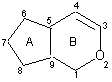
Cyclopentane pyran
Let’s start with aucubin, as it is first alphabetically, and among those iridoids you need to know, it apparently has the simplest structure. Only it and valtrate, which we will consider among the valepotriates, have a partially dehydrated cyclopentane ring. That is – the dehydrated iridoid is our very first.
Aucubin contains 2 –OH groups in the cyclopentane ring – one opposite the other: the upper group is independent, while the lower one is part of –CH2OH.
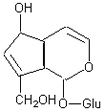
Aucubin
If in the molecule of aucubin the double bond in the cyclopentane ring is broken and an oxygen atom is incorporated into it, thus forming a new three-membered lactone ring, such a cyclopentane iridoid is called catalpol.
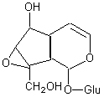
Catalpol
Another cyclopentane iridoid – loganin – has adjacent –OH and –CH3 groups in the cyclopentane ring, and in the pyranose ring, besides the oxygen atom, which I hope you are already familiar with from the first two iridoids, to which a glucose residue is attached, there is a –COOCH3 group (that is, do not forget – in the lower part of the pyranose ring – 2 oxygen atoms and in the upper part – 2 oxygen atoms).
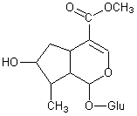
Loganin
When the cyclopentane ring is opened between the adjacent –OH and –CH3 groups with their parallel dehydration (the groups =O and =CH2 are formed, respectively), loganin turns into a secoiridoid secologanin. Here we will immediately say that secoiridoids are iridoids with an opened cyclopentane cycle.
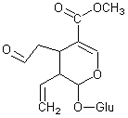
Secologanin
The remaining two secoiridoids that we will consider – sverozid and genciopicroside (= genciopicrin) – are very similar to each other in structure and differ only by the presence or absence of one double bond. They do not have a cyclopentane ring, but instead contain another pyranose. Their lower part is the same as that of secologanin, while in the upper part there is a second pyranose ring, which has a carbonyl group next to the heteroatom O. That is, both sverozid and genciopicrin have 2 oxygen atoms in both the upper and lower parts of the molecule (remember loganin?).
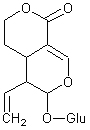
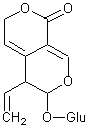
Sverozid Genciopicroside
(= Genciopicrin)
In genciopicroside, the upper pyranose ring is unsaturated (one double bond located parallel to the double bond in the lower pyranose ring) unlike sverozid. This can be remembered by analogy with aucubin (first alphabetically and has an unsaturated ring; and genciopicroside is also alphabetically positioned earlier compared to sverozid).
Iridoids of the Valerianaceae family – valepotriates – belong to cyclopentane iridoids.
The name “valepotriates” can be broken down into three components, telling us that, firstly, they are iridoids of the valerian family (val-); secondly, that they necessarily have an epoxide group (-epo-), and thirdly, about their triester nature (three times complex esters; -triates).
Valepotriates differ in the degree of saturation of the cyclopentane ring and the nature of the isovalerenic acid residues (isovalerenic and acetoxyisovalerenic), which are attached to the cyclopentane pyran skeleton at positions C1 and C7.
If both isovalerenic acid residues are attached at C1 and C7, such compounds are called valtrates; if at C1 – isovalerenic acid, and at C7 – acetoxyisovalerenic acid, they are called valepotriates.
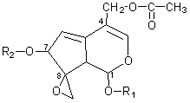
It is easy to remember that dihydrovaltrate is a doubly hydrated valtrate, that is, in the first there is no double bond in the cyclopentane ring, while in the second there is. The same can be said about dihydrovalepotriate and valepotriate.
Two more common features of the structure of all valepotriates are:
- the presence of a “triangle” – a three-membered heterocyclic ring attached at one of the corners at position C8;
- a chain –CH2–O–CO–CH3 at position C4, which can be viewed as an acetoxy group –O–CO–CH3 (which we will remember later), attached to the edge methyl group –CH3 of the pyranose ring, which thus turns into a –CH2 group as part of the overall chain.
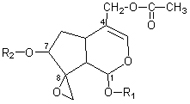
R1 = R2 = isovalerenic acid – Dihydrovaltrate;
R1= isovalerenic acid;
R2= acetoxyisovalerenic acid – Dihydrovalepotriate
You only need to memorize the formulas of isovalerenic and acetoxyisovalerenic acids. This will be easier to do if you remember what an acetoxy group –O–CO–CH3 is. In the case of acetoxyisovalerenic acid, it is attached to the carbon atom –CH of the isovalerenic acid instead of hydrogen (this carbon atom can be said to be “central” in the molecule of isovalerenic acid, since it is also attached to two –CH3 groups and one –CH2).
Just in case, I remind you once again that, like any carboxylic acids, isovalerenic and acetoxyisovalerenic acids must necessarily contain a –COOH group.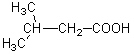 Isovalerenic acid
 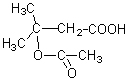 Acetoxyisovalerenic acid