Abu Rayhan al-Beruni
Welcome! Khush kelibsiz! Қош келдіңіз! Кош келдыныздер! Hoş geldiňiz! !ترحيب
Genius people do not die. Because their intellectual, emotional, and spiritual universe is so rich, vast, and multifaceted that after their physical death, we feel not only their influence but also their invisible presence. We relate our actions to them, seek their advice, and learn. And therefore, from distant centuries, the great teacher Beruni addresses us today.
 “Saydana (Pharmacognosy) is the knowledge of the nature
of medicinal substances and the art of understanding
their names and forms”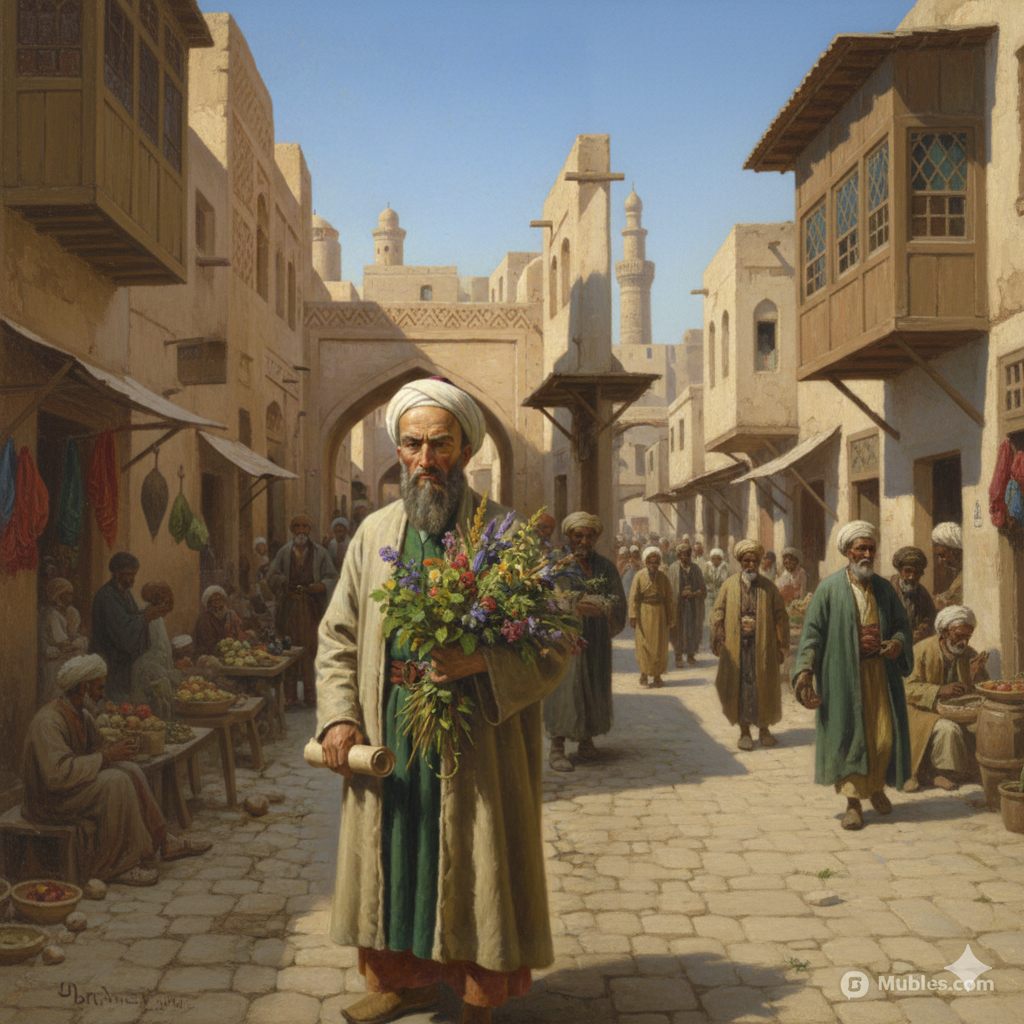 “Nature’s mercy is boundless, for in every flower it has hidden a secret to overcome illness”
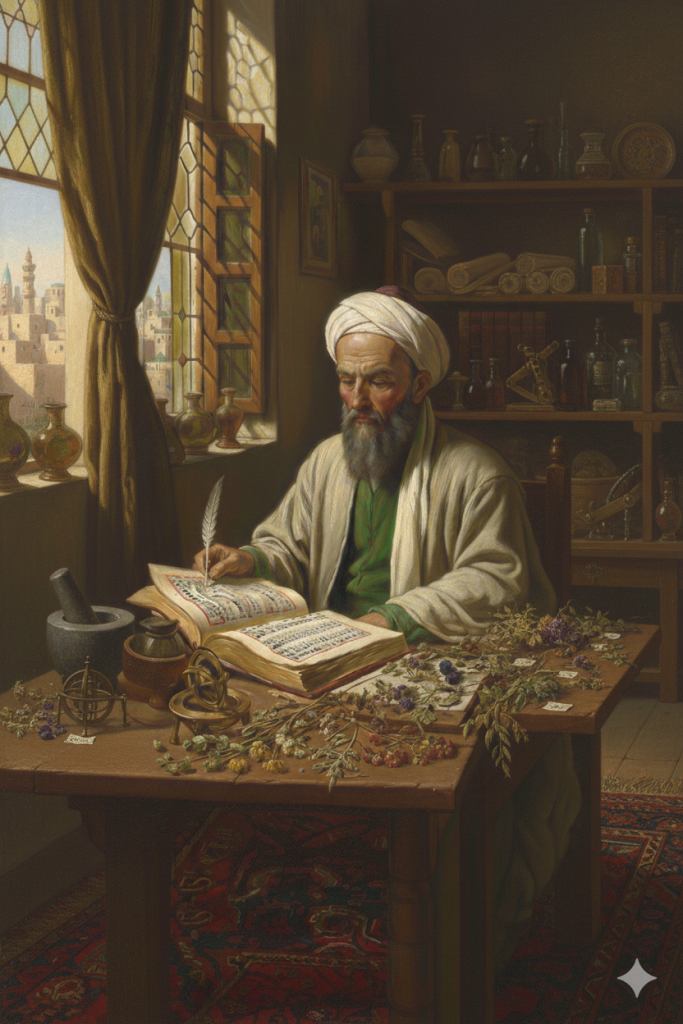 “The first law is the precise knowledge of every herb”
Abu Rayhan Beruni (Biruni; Abu Rayhan Muhammad Ibn Ahmad al-Biruni)
(973–1048). 75 years
Born on September 4, 973, in the ancient capital of Khorezm – the city of Kiat. Very little is known about Beruni’s early years, except that he was a complete orphan. He wrote about his origin: “…I do not truly know my ancestry. For I do not truly know my grandfather, and how can I know my grandfather if I do not know my father!”.
In childhood, due to his large nose, he earned the nickname “Burunly” (“big-nosed”). But besides his expressive appearance, from a young age, Beruni was distinguished by a perceptive mind, excellent memory, and an irresistible thirst for knowledge.
The hypothesis about Beruni’s origin from the urban lower classes (which has almost been established in scientific literature) was justly questioned by the leading researcher of Beruni’s life and work, P.G. Bulgakov. According to P.G. Bulgakov, such a hypothesis does not explain how Beruni, as a child, found himself in the palace of the Iroquois dynasty, where, according to his own admission, he was treated like a son and received an excellent education; why he “quickly approached the figure of the very Khorezmshah”.
Abu Nasr was sincerely attached to his pupil, and this attachment lasted a lifetime, continuing to tenderly care for him and give advice, even when the scientific fame of the student far surpassed his own. Over the years, mentorship gave way to collaboration, and the spiritual closeness of these two people, who placed selfless service to truth above all earthly goods, would determine the remarkable similarity of their human paths – fate, which often and for long periods separated them, would ultimately bring both together in exile, where both would end their lives without ever seeing their homeland. The inquisitive Beruni from childhood sought to expand the knowledge of the world he received from his tutor. In his work “Pharmacognosy in Medicine,” he wrote that by nature, he was endowed with excessive greed for acquiring knowledge from a young age. As evidence of this, Beruni gives the following example: when he was about seven years old, a Greek settled in their area, to whom he brought various grains, seeds, fruits, plants, and so on, asking what they were called in his language and recording the names. Later, the Greek introduced Beruni to another knowledgeable person named Masihi, who recommended necessary books for reading and explained unclear things. His first work “Chronology of Ancient Peoples,” in which he gathered and described all known calendar systems used by various peoples at that time, was written when he was just over twenty years old.
The similarity of Beruni’s earthly path with the fate of another great contemporary – Abu Ali Ibn Sina, with whom they actively exchanged letters discussing Aristotle’s natural philosophical views, is also remarkable.
Like Ibn Sina, fate lifted Beruni up and then struck him down: years of peaceful life filled with scientific research and palace honors were replaced by years of poverty and exile.
Beruni had to experience the loss of all his manuscripts several times and start everything from scratch in a new place. But the strength of spirit and the pursuit of scientific inquiry did not allow Beruni to give up even in hopeless situations.
Since 1017, after the conquest of Khorezm by Sultan Mahmud of Ghazni, Beruni lived in Ghazni at the court of Sultan Mahmud and his successors Masud and Maudud. At the sultan’s insistence, Beruni participated in Mahmud’s campaigns in India, where he spent the second half of his life. There are many legends about the circumstances of his move to Ghazni. Did he voluntarily go to the capital of Sultan Mahmud in search of good earnings, or was he forcibly taken there under guard and in chains, like a dangerous criminal? Most researchers lean towards the second version: when in 1017 the capital of the Khorezm principality was destroyed, the great scholar was captured and “as a captive-hostage, he, along with other prominent Khorezmians, was taken to Ghazni” and was even imprisoned there. After his release in Ghazni, the scholar led a secluded life, and only work remained his only joy.
Only for two days a year – on New Year’s Day and during the festival of Mihrajana – he devoted himself to the concerns of acquiring food and clothing, while on the remaining days of the year, he fully dedicated himself to science.
There is a legend that once Sultan Mahmud himself decided to test Beruni’s logic and knowledge. For this, he arranged an audience in the large hall of his palace, which had four doors. And he commanded him to guess through which of them he would enter the hall. Beruni immediately asked for paper and ink, and, writing a note containing the answer, hid it under the pillow on which the sultan usually sat. The sultan ordered a part of the wall in the hall to be broken down and entered through the breach. Upon taking out the note from under the pillow, he found the answer that the sultan should enter the hall through the breach in the wall.
Enraged, Mahmud ordered that the scholar be thrown out of the window, but Beruni had previously instructed to prepare a slope under the window, down which he slid without any harm to himself.
In old age, Beruni lost his sight, but until the last moment of his life, he considered the “mechanism” of life continuation to be a vigorous spirit. Dying on December 9, 1048, in Ghazni, Beruni was fully conscious and, although weak, engaged in discussions on scientific topics. Bidding farewell to friends, he asked the last one: “Ah yes, I always wanted to ask, what did you once tell me about the methods of counting unjust profits?”. The astonished friend exclaimed: “Is this what you are talking about now!”. Beruni, already losing his voice, whispered: “Oh you! I think it is better to leave the world knowing the answer to this question than to depart as an ignorant…”.
Beruni was an encyclopedically educated person with diverse interests. He learned Arabic language, grammar, and stylistics by himself. In addition, he knew nine Eastern languages (besides Khorezmian and Arabic), including Sanskrit and Hindi, as well as Greek and Latin.
Beruni’s monumental work “Pharmacognosy in Medicine” (“Kitab as–Saydana fit–t–tibb”) is of great significance even today. In this book, he described in detail about 880 plants, their individual parts and extracts; provided their precise descriptions, organized the terminology. The description of plants is accompanied by illustrations depicting them. “Saydana” (“Pharmacognosy”) also contains rich material on the distribution of medicinal plants and their habitats.
Beruni collected and explained about 4500 Arabic, Greek, Syrian, Indian, Persian, Khorezmian, Sogdian, Turkic, and other names of plants. These synonyms are still used in modern pharmacognosy when deciphering ancient treatises.
For European science, “Saydana” (“Pharmacognosy”) was unknown until 1902.
Beruni’s aphorism: “A scholar acts consciously even when spending money”.