How to Remember Alkaloid Formulas
the exam will not be postponed.
A.P. Orekhov in 1937 classified alkaloids into protoalkaloids (the nitrogen atom is not part of a heterocycle but is in the side chain, formed from amino acids), true alkaloids (the nitrogen atom is part of a heterocycle, formed from amino acids), and pseudoalkaloids (the nitrogen atom is part of a heterocycle, having terpenoid origin).
It is customary to distinguish 14 cycles of true alkaloids, based on which many alkaloid molecules exist in the plant world. We will start by examining them and then move on to individual representatives.The starting 5-membered cycle of true alkaloids is pyrrolidine. This is a typical cyclopentane ring, in which the central hydrogen atom is replaced by a nitrogen atom.

Pyrrolidine
Two cyclopentane rings with a nitrogen atom at their junction form pyrrolizidine. Remember that a compound whose name ends with “–lizidine” (pyrrolizidine, quinolizidine, indolizidine) necessarily has two fully saturated rings (that is, it has no double bonds), at the junction of which is a nitrogen atom.
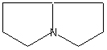
Pyrrolizidine
If two cyclohexane rings are interlocked, with the nitrogen atom located in the center of the inner ring and carrying an –CH3 group, such a molecule is called tropane.
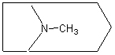
Tropane
The starting 6-membered cycle of true alkaloids is piperidine – a cyclohexane ring with a nitrogen atom.
To avoid confusing pyrrolidine with piperidine, as is often the case with students, remember this simple rhyme:
Lida our pirouetted –
Ate five bowls of porridge.
If there’s Piper in the porridge, –
She’ll eat six more bowls!
(Piper [nigrum] – this is common black pepper… Remember from the botany course?)

Piperidine
If the alkaloid cycle involves not a cyclohexane (fully saturated) but a benzene ring (fully unsaturated), then we are dealing with pyridine.

Pyridine
The molecule of quinolizidine could perhaps be more logically named piperolizidine, since it is built on the basis of piperidine similar to pyrrolizidine, that is, it has two fully saturated cyclohexane rings, at the junction of which is a nitrogen atom.
To remember this, we will connect the concept of piperidine – quinolizidine with this rhyme:
Liza’s Piper will replace the quinine –
No one will deceive Liza twice!
Besides hinting at Liza’s vengeful character, “twice” here certainly refers to the two cyclohexane rings (two piperidine molecules).

Quinolizidine
Two benzene rings in the molecule contain two structures with one nitrogen atom – quinoline and isoquinoline (they differ only in the position of this nitrogen atom) – and one molecule with two nitrogen atoms – chinazoline.

Quinoline Isoquinoline Chinazoline
In the quinoline molecule, the nitrogen atom is located at the bottom of the right benzene ring, and when forming isoquinoline, it migrates one position up (that is, these two compounds can be conditionally considered as isomers).
Chinazoline contains two nitrogen atoms, one of which is located as in quinoline, and the second – one position up.
The name “chinazoline” is easy to remember because, firstly, it is similar to quinoline, and secondly, it contains an additional nitrogen compared to quinoline.
Indolizidine, as you have already understood from the name, has two fully saturated rings, at the junction of which is nitrogen. The peculiarity of the molecule is that these rings are different, that is, one is cyclohexane, and the other is cyclopentane.

Indolizidine
Those who have been to India know that there, great luxury and great poverty coexist peacefully. So remember – in indolizidine, different rings – 5- and 6-membered – are also nearby.
When these rings are fully saturated, and nitrogen is located at the bottom of the right ring, this is indole. Recall benzene – also a fully saturated compound. This will make it easier for you to learn indole following indolizidine. And, as we observed in the pair: quinolizidine – quinoline, nitrogen behaves similarly in the pair indolizidine – indole.

Indole
A saturated compound based on a cyclopentane ring that contains two nitrogen atoms, located one apart, is called imidazole.

Imidazole
If we add a benzene ring with two more nitrogen atoms to the imidazole ring, we obtain purine. Just note that when forming purine, the hydrogen from the lower nitrogen atom (where it is located in the imidazole molecule) migrates to the side. Accordingly, the nature of the arrangement of double bonds also changes.
Purine contains the highest number of nitrogen atoms of all alkaloid cycles – 4, which you need to remember:
Here are four mandarins –
As nitrogen in purine.
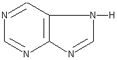
Purine
And the last cycle of true alkaloids is acridine, built from three conjugated benzene rings. It contains one nitrogen atom, located in the central ring at the bottom, and this atom carries a methyl group. Remember, the methyl group that branches off from the nitrogen atom is also present in the tropane molecule. The name “acridine” has 3 syllables – this may help you remember that it has 3 benzene rings.
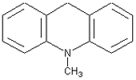
Acridine
Now let’s move on to the examination of individual representatives of alkaloids. Read more…