How to remember the formulas of coumarins
feelings cannot be weighed.
How to remember the formulas of coumarins?
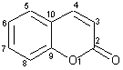
(= Coumarin)
Simple coumarins are usually formed quite simply: by the addition of hydroxyl or methoxy groups to the coumarin skeleton, most often at the C7 and C6 positions.

Umbelliferone Esculetin Scopolin Fraxetin
The most well-known coumarin – umbelliferone – contains one –OH group at the C7 position (that is, mirror-symmetrically to the carbonyl).
In esculetin, there are two –OH groups – at the C7 and C6 positions.
If the hydrogen at C6 is replaced by a methyl group, then this compound is called scopolin. This can be remembered by drawing an analogy with the first letter of the word scopolin – “s” – and “CH3“, that is: the compound whose name begins with the letter “s” has a –CH3 group.
By adding another –OH group to scopolin – at the C8 position – we obtain fraxetin.
These are the main simple coumarins that you need to know.
Furano-coumarins (= furocoumarins), as their name suggests, have, in addition to the benzo–alpha–pyrone system, a furan ring. It is unsaturated and has one double bond; it can attach either linearly (at C6–C7) or angularly (at C7–C8). You are already familiar with these terms after studying xanthones.

Psoralen Angelicin Bergapten Xanthotoxin
If one furan ring is linearly attached to the molecule of benzo–alpha–pyrone, this compound is called psoralen. With angular attachment, we obtain angelicin (the name even sounds similar: angular attachment – angelicin).
In the case where the psoralen molecule is methoxylated at the C5 position (that is, in the middle of the molecule, above the benzene ring, the –OCH3 group is attached), this compound is called bergapten.
If methoxylation occurs at C8 (below the benzene ring), we obtain xanthotoxin.
Pyrano-coumarins, again according to their name, contain in their structure a pyranose ring, which is attached angularly. The pyranose ring has one double bond in its structure, that is, like the furanose in furanocoumarins, it is also unsaturated.
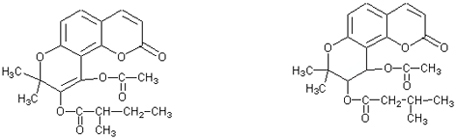
Visnadin Dihydrosamidin
You should know two pyrano-coumarins – visnadin (do not confuse with visnagin, which belongs to the class of chromones, and which we will consider a little later!) and dihydrosamidin.
They are very similar to each other in structure and differ in the presence or absence of a double bond in the pyran cycle and the position of the –CH2– group in one of the side chains.
Dihydrosamidin is named “dihydro” because it is a doubly hydrogenated compound (i.e., with two hydrogen atoms) compared to samidin and visnadin, and therefore does not have double bonds in the pyran cycle. All carbon atoms in the pyran cycle of both visnadin and dihydrosamidin have substituents. To the carbon atom closest to the oxygen heteroatom, two –CH3 groups are attached; the next carbon atom has a radical, the position of which –CH2– distinguishes visnadin from dihydrosamidin; the third carbon atom carries an acetoxy group (the fourth and fifth carbon atoms, as we remember, are attached to the benzene ring).
You should also know the radical that distinguishes visnadin from dihydrosamidin. If we insert an additional –CH(CH3)–CH2– group between the acetoxy group –O–CO–CH3 and –CH3, we obtain visnadin, and if in the reverse order: –CH2–CH(CH3)–, then we obtain dihydrosamidin. Let this be a hint for you that “dihydro” means 2 hydrogen atoms, and the –CH2– group indeed contains that number (although we remember that the prefix “dihydro” is used in the name of the compound in a completely different context). Then let’s remember that in dihydrosamidin the –CH2– group is located immediately after –CO–, before –CH(CH3)–, while in visnadin it is located after –CH(CH3)–.
You should have no problems with benzocoumarins: as their name suggests, they contain a coumarin skeleton and an additional benzene ring.
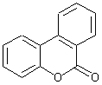
3,4–Benzocoumarin
And the last subgroup of coumarins that we will consider – cumestans – is characterized by the presence of both a furanose ring and a benzene ring. The most well-known cumestan – cumestrol – contains, like umbelliferone, an –OH group at the C7 position. That is, it can be considered as umbelliferone with two additional rings – a furanose and a benzene.
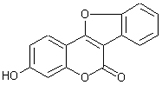
Cumestrol
A closely related class of natural compounds to coumarins are chromones (see below).