How to Remember Lipid Formulas
a taste for growth is essential!
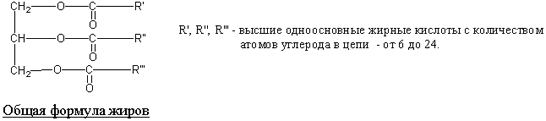
Therefore, your only task at the moment is to recall the formulas of these fatty acids.
Saturated acids are very easy: in their formulas, the groups –CH2 are arranged one after another (just remember that at one end there is the group –CH3, with the carbon atom at this end assigned the number “omega” – the last letter of the Latin alphabet; and at the other end – COOH, respectively, the carbon atom in this group is assigned the number “alpha” – the first letter of the Latin alphabet).
The only thing to know here is that palmitic acid has 16 carbon atoms; stearic acid has 18; arachidonic acid (= eicosanoic acid) has 20.
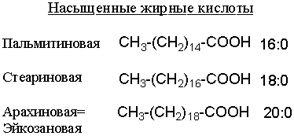
The sequence can be remembered with a little rhyme:
On sixteen palms, candles burn,
Eighteen candles shine with stearin.
Peanuts ripen in twenty districts,
And eighteen olives in green meadows.
The phrase “eighteen olives” indicates the number of carbon atoms in oleic acid, whose name comes from the source of its discovery – the oil of the common olive (Olea europaea = olive oil). But this is already an unsaturated acid, which has one double bond in its structure (designated 18:1).
Oleic acid (18:1, omega-9)
By the way, regarding the unsaturated fatty acids that you need to memorize, the total number of carbon atoms is the same – 18, except for arachidonic acid, which has 20. The difference lies only in the number of double bonds.
I remind you that the numbering of carbon atoms in fatty acids starts from the –COOH group, designating its carbon atom as “alpha,” while the carbon atom in the –CH3 group is assigned the number “omega.” It is not difficult to remember this, as even the letter “omega” resembles the number 3 lying on its back (drawing an analogy with the –CH3 group).
It is important for us to know this, as we need to memorize the biogenetic families of fatty acids: “omega–3,” “omega–6,” and “omega–9.”
You can read more about the biological role of omega–3 and omega–6 fatty acids, as well as which acids and in what amounts are needed by humans, here…
The numbers 3, 6, and 9, indicated after the letter “omega,” show us the position of the double bond closest to the –CH3 group.
Thus, in oleic acid (see above), there is one such bond (monounsaturated acid), and it is located between the 9th and 10th carbon atoms, i.e., after the 9th atom. Therefore, oleic acid belongs to the “omega–9” fatty acids.
Linoleic acid has two double bonds. This acid belongs to the “omega–6” fatty acids, so one double bond is located after the 6th carbon atom from the –CH3 end:
Linoleic acid (18:2, omega-6)
In the molecule of alpha-linolenic acid, there are three double bonds. Linolenic acid exists in two main forms: alpha-linolenic acid and gamma-linolenic acid. Of these, alpha-linolenic acid belongs to the “omega–3” fatty acids and has the structure:
Alpha-linolenic acid (18:3, omega-3)
Gamma-linolenic acid belongs to the “omega–6” fatty acids, and its structure is, accordingly, as follows:
Gamma-linolenic acid (18:3, omega-6)
To better remember the number of double bonds in the main polyunsaturated fatty acids, we will again use a humorous rhyme:
Linol – double fold.
Lazy Lena has a triple in hygiene.
The molecule of arachidonic acid, like arachidic acid, contains 20 carbon atoms, but also has 4 double bonds. This acid belongs to the “omega–6” fatty acids, so its structure is as follows:
Arachidonic acid (20:4, omega-6)
It is worth mentioning that arachidonic acid is also called eicosatetraenoic acid. “Eicosa” means 20 in Greek (hence arachidonic acid is also called eicosanoic), and “tetraenoic” means having 4 double bonds.
Polyunsaturated “eicosa-acids” – 20:3, 20:4, 20:5 – are the main source for the subsequent synthesis of eicosanoids (hence the name), which include prostaglandins, thromboxanes, and leukotrienes.
Another acid that you need to know is ricinoleic acid, which is structurally similar to oleic acid (has one double bond), but contains a hydroxyl group at C12. That is, it is an oxyacid. It is the main component of castor oil.

Ricinoleic acid (18:1, 12 OH, omega-9)