How to Remember Lignan Formulas
it is fraught to agree
with everything.
How to remember the formulas of lignans?
Since all lignans are derivatives of diphenylpropane, there are always two such benzene rings (“heads”) and propane chains (“tails”) in lignans. True lignans and neolignans differ from each other by the position of attachment of these two “heads” and “tails.”
True lignans have a beta–beta’ bond (“tail” to “tail”), while neolignans have an alpha–”head”‘ bond (“tail” to “head”).
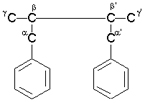
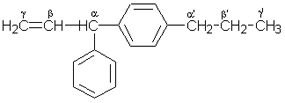
Structure of true lignans Structure of neolignans
In the construction of lignoid molecules, other classes of compounds participate – flavonoids (in flavolignans), xanthones (in xantholignans), coumarins (in coumarinolignans).
You need to know 4 main formulas of lignans. These are true lignans syringaresinol, eleutheroside E, and schisandrin (they have adaptogenic effects), and the flavolignan silibinin with hepatoprotective properties.
Syringaresinol is the aglycone of eleutheroside E (that is, its non-sugar part); both compounds (as can be inferred from the name of the glycoside) are found in the rhizomes and roots of Eleutherococcus.
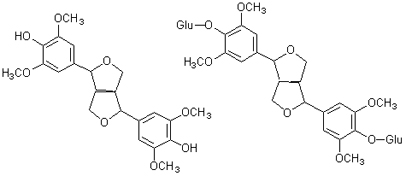
Syringaresinol Eleutheroside E
I personally really liked it when one of my students during practical classes, after being assigned to draw the formula of syringaresinol, started doing it from the middle of the formula – from the two connected five-membered lactone rings. This turned out to be very convenient for subsequent construction of the molecule, and therefore I recommend you do the same. Here, it is also necessary to remember that each of the two symmetrical benzene rings of syringaresinol is attached to 3 groups, two of which –OCH3 are located at the edges, and between them is the –OH group. This is not very difficult to grasp, because later you will replace the hydrogen atom in each of these –OH groups with a glucose molecule, thus obtaining the diglycoside of syringaresinol – eleutheroside E.
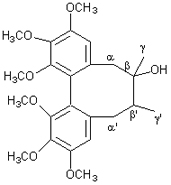
Schisandrin
A somewhat different way of joining the benzene rings (“heads” of the two lignan subunits), which resembles honeycombs, is seen in the molecule of schisandrin, only, unlike honeycombs, the cell connecting the benzene rings is 8-membered, not 6-membered. To remember this, as well as what we need to do next when constructing the molecule of schisandrin, let’s recall the propane chain of each lignan subunit and the three carbon atoms – alpha, beta, gamma (where they are located, see the figure). In addition, remember that a methyl group with the gamma carbon atom is attached to the beta position of the upper subunit, as well as an –OH group. Also add 3 –OCH3 groups to each benzene ring, and then you will have no problems with the molecule of schisandrin.
The flavolignan silibinin, based on its name, is found in the seeds of milk thistle (Silybum marianum). Its structure is based on a flavonoid molecule, and you will still have to memorize it. It is better to do it right now.
Flavonoids are compounds that have the structure C6C3(with a heteroatom O)–C6, and often a keto group is located opposite the oxygen heteroatom (flavones, flavanones, the suffix -one indicates that the compound is a ketone). Flavonoid molecules contain various substituents and differ in the presence or absence of double bonds. Their presence and arrangement determine which specific flavonoid it is (we will discuss this later).
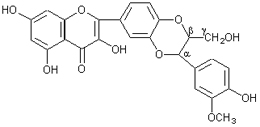
Silibinin
In the case of silibinin, we are dealing with a compound that in the flavonoid part C6C3 contains 3 –OH groups, two of which surround the keto group, with one positioned parallel to the keto group, and the second forming a diagonal with the third –OH group. As for the direct attachment of the lignan subunit to the –C6 part of the flavonoid, it can be considered that it attaches at both the alpha and beta positions to the two –OH groups of the –C6 part of the flavonoid (the hydrogen atoms are removed, and a lactone ring is formed containing two heteroatoms of oxygen). In the gamma position of the propane chain in silibinin, there is a –CH2OH group.