Garlic and Testosterone
Garlic and Testosterone: It’s Not That Simple…
Does garlic truly boost male hormone levels?
Nowadays, the internet is flooded with websites claiming that garlic is a man’s best friend, allegedly increasing testosterone levels, enhancing potency, and boosting overall male vitality.
These conclusions are largely based on several studies from the 1990s and early 2000s (specifically by a group of Japanese scientists, Oi Y. et al., 1995–2001), which investigated the effects of dry garlic powder on testosterone levels in rats.
However, few are aware of more recent studies (2003–2011) that provide completely opposite results regarding garlic. This is not surprising, as these modern “fresh” findings are rarely mentioned on popular health resources.
Considering that high testosterone levels in women can lead to infertility, menstrual cycle disorders, and “male-pattern” hair growth, it is equally important for women to have an accurate understanding of how garlic consumption affects testosterone in the body.
Let’s look at the evidence.
In a series of scientific papers by Japanese researchers Oi Y., Kawada T., Kitamura K., et al. (1995–2001), the effects of dry garlic powder and its primary sulfur-containing compounds on the secretion of luteinizing hormone (LH) were examined. LH is released by the pituitary gland and controls testosterone synthesis in the body.
The results showed that LH secretion increased with higher doses of diallyl disulfide—a component of dry garlic powder—subsequently increasing the amount of testosterone produced in the testes. The authors suggested that diallyl disulfide enhances norepinephrine secretion, triggering a biochemical chain reaction that leads to higher LH and testosterone levels.
The Turning Point: Fresh Garlic Findings
In a more recent study by Hammami I., Nahdi A., Mauduit C., et al. (2008), the effects of chronic consumption of fresh crushed garlic on male reproductive functions in rats were studied. Researchers measured testosterone levels in the testes and plasma, LH levels, prostate mass, sperm density, and testicular integrity.
The Results: Researchers found a significant increase in empty seminiferous tubules, a decrease in prostate and seminal vesicle mass, and—most importantly—a decrease in testosterone levels in both testicular tissue and blood plasma.
Similar data was reported by Abdelmalik S.W. (2011), describing apoptosis (cell death) of testicular cells and disrupted spermatogenesis resulting from chronic raw crushed garlic consumption. The author suggests two possible mechanisms:
1. Garlic, as an anti-hypercholesterolemic agent, may inhibit steroidogenesis.
2. It may exert a direct estrogen-like effect on the testes.
Interestingly, the decrease in testosterone was associated with increased levels of LH. This suggests that components of fresh crushed garlic reduce the sensitivity of Leydig cells to LH and/or directly inhibit steroidogenesis in the testes.
Chemistry: Why the Contradiction?
The discrepancy in results is likely due to the type of garlic preparation used. Fresh crushed garlic and dry garlic powder contain different concentrations of bioactive substances.
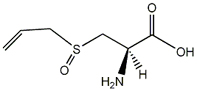 Alliin (Stable, odorless compound)
Under the influence of the enzyme alliinase, which is released when the bulb is crushed, alliin rapidly breaks down to form allicin.
 Allicin (Diallyl thiosulfinate)
Allicin is highly reactive and immediately transforms into various bioactive substances, such as ajoene.
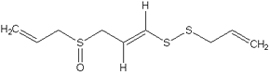 Ajoene
Researchers like Prasad S., Kalra N., Shukla Y. (2006) link the decrease in testosterone to diallyl sulfide. They suggest that diallyl sulfide inhibits testosterone-mediated oxidative damage in prostate and liver tissues.

Diallyl disulfide

Diallyl sulfide

Dimethyl trisulfide
Final Verdict
The primary difference lies in allicin: it is present in fresh garlic but absent or significantly lower in many processed powders. Since allicin is responsible for the cholesterol-lowering (hypocholesterolemic) effect, it is likely the factor that inhibits steroidogenesis.
This may occur through:
1. Affecting cholesterol mobilization to the mitochondria of Leydig cells.
2. Disrupting mitochondrial translocation of cholesterol.
3. Blocking the conversion of cholesterol into testosterone by inhibiting key regulatory enzymes.
In conclusion, fresh garlic is indeed a powerful supplement: it lowers “bad” cholesterol and blood pressure, acts as an antimicrobial, thins the blood, and helps prevent certain cancers. However, it also appears to reduce testosterone levels. So—do not overindulge!
Studies reporting increased testosterone:
Oi Y., et al. Garlic supplementation enhances norepinephrine secretion… // J. Nutr. Biochem. – 1995.
Oi Y., et al. Alliin and volatile sulfur-containing compounds in garlic enhance thermogenesis… // J. Nutr. Biochem. – 1998.
Oi Y., et al. Garlic supplementation increases testicular testosterone… // J. Nutr. – 2001.
Studies reporting decreased testosterone:
Abdelmalik S.W. Histological and ultrastructural changes in the adult male albino rat testes… // Ann. Anat. – 2011.
Chakrabarti K., et al. Sperm immobilization activity of Allium sativum L. and other plant extracts // Asian J. Androl. – 2003.
Hammami I., et al. The inhibitory effects on adult male reproductive functions of crude garlic feeding // Asian J. Androl. – 2008.
Prasad S., et al. Modulatory effects of diallyl sulfide against testosterone–induced oxidative stress… // Asian J. Androl. – 2006.
Additional Literature:
Нефедова А.В., Киселева Т.Л. Лук и чеснок в фитотерапии и гомеопатии… // Традиционная медицина. – 2004.
Слепко Г.И., и др. Биологически активные компоненты чеснока… // Вопросы питания. – 1994.
Amagase H., et al. Intake of garlic and its bioactive components // J. Nutr. – 2001.
McRae M.P. A review of studies of garlic on serum lipids and blood pressure… // J. Chiropr. Med. – 2005.
Touloupakis E., Ghanotakis D.F. Nutraceutical use of garlic sulfur-containing compounds // Adv. Exp. Med. Biol. – 2011.
Zhang X.H., et al. A randomized trial of the effects of garlic oil upon coronary heart disease risk factors… // Blood Coagul. Fibrinolysis. – 2001.