Galen Claudius
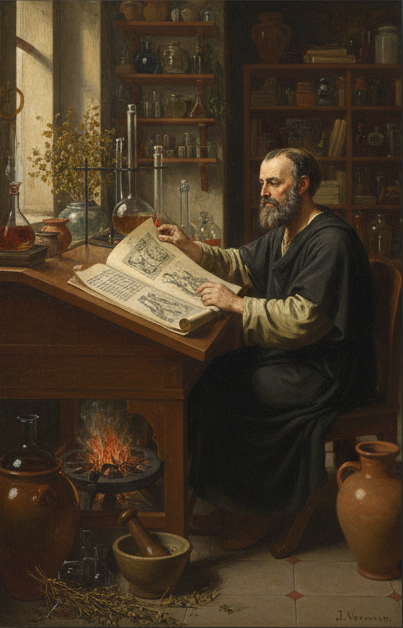 “Nature is the primary physician, and plants are its most perfect instrument”
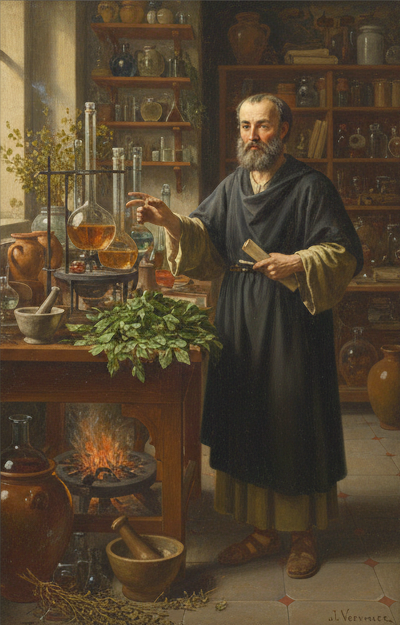 “The art of healing lies in extracting the curative power from plants”

Claudius Galen (131–201 AD). 70 years
Born in Pergamum, the son of the architect Nikon. After thorough and comprehensive study of philosophy with representatives of the four main schools of that time: Stoic, Platonic, Peripatetic, and Epicurean, Galen began studying the art of medicine at the age of 17, training with various renowned physicians in his hometown, Smyrna, and Corinth. To expand his knowledge, he undertook a journey to Lycia and Palestine, after which he lived for a long time in Alexandria, the center of the scholarly world of that time, to improve himself primarily in anatomy.
Galen’s journey to Alexandria greatly broadened the scope of his knowledge and interests. He eagerly observed and studied all the sciences that interested him. Galen knew all the Greek dialects, as well as Latin, Ethiopian, and Persian languages. He spent more than 6 years traveling, and when he returned to Pergamum, he became a physician in the gladiatorial school, where he practiced surgery for 4 years. In 164, the 33-year-old scholar moved to Rome and soon became popular there as an educated lecturer and experienced physician; he was known to the emperor and philosopher Marcus Aurelius, and became close to the Peripatetic Eudemus, a well-known philosopher in Rome whom he cured and who praised him as the most skilled physician.
At the same time, he experienced a severe shock – the loss of his manuscripts, which were burned in a fire at the Temple of Peace. In Rome, Galen wrote many works, including his main anatomical-physiological treatise “De usu partium corporis humani” – “On the Function of the Parts of the Human Body”.
Galen wrote no less than 300 works, primarily on medical, as well as philosophical, mathematical, and legal subjects. About 80 of his medical works have survived to this day. They concern anatomy, physiology, pathology, pharmacology, therapy, hygiene, dietetics, obstetrics, and embryology. He highly valued the significance of plants as medicinal agents and initiated the production of extraction preparations, widely known as Galenic preparations.
Galen’s aphorism: “The physician is a helper of nature.”