How to Remember the Formulas of Xanthones

 Rule eight:
     we do not ask for leniency.

How to remember the formulas of xanthones?

  We have just completed the study of lignan formulas by examining the structure of flavolignans and, in particular, flavonoids that are part of their composition. At the moment, the knowledge we have gained will be useful.
  If flavonoids have the structure C6C3(with a heteroatom O)–C6, where a ketogroup is often located opposite the heteroatom, then true xanthones are practically the same, but C6C3(with a heteroatom O)C6 (the ketogroup remains).
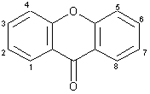
ksantony   

  Structure of true xanthones

  From true xanthones, you should know the formula of mangiferin. This is a glycoside, whose aglycone is a xanthone containing 5 –OH groups (only one C8 position remains free). When forming mangiferin, one –OH group is glycosylated (at the C2 position). As the name suggests, mangiferin was first isolated from mango (in Latin Mangifera indica), and it is also found in St. John’s wort and alpine pennyroyal.
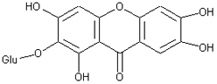
   mangiferin

  Mangiferin

  It is not difficult to guess that in the formation of furanoxanthones, in addition to the xanthone structure C6C3C6, a furanose ring is also involved (let’s remember fructose!), and in the formation of pyranoxanthones – a pyranose ring (the base of glucose).
  The furanose ring attaches to the xanthone base “at the foot” to the upper part of the benzene ring, and the first resembles a fish, where the oxygen atom appears as a “head,” opposite which is a “tail” formed by two –CH3 groups.
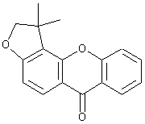
  furanoksanton

  Structure of furanoxanthones

   Pyranoxanthones are represented by linear, angular, and dipyranoxanthones.
  In linear pyranoxanthones, the pyranose ring attaches linearly, in angular ones (from English angular – angle) – at an angle (to the lower part of the benzene ring), and in dipyranoxanthones, there are two pyranose rings that can be attached in both ways.

piranoksantony

                                             Structure of linear               Structure of angular                        Structure
                                                of pyranoxanthones                     of pyranoxanthones                       dipyranoxanthones

Similar Posts

  • Theses Abstracts

    Theses Abstracts 1. Makovetska O.Yu. Biologically active substances of the genus Hypericum L. as a source for the creation of medicinal products with specified properties. – Abstract of the dissertation … Dr. of Pharm. Sciences: 15.00.02. – Kyiv, 2002. – 37 p. 2. Makovetskaya E.Yu. Biological features and comparative assessment of biologically active substances of…

  • Chromium: Goodbye, Diabetes and Obesity!

            Chromium (Cr)        Goodbye, diabetes and obesity!         Chromium is an essential element that in the human body activates enzymes involved in carbohydrate metabolism; in the synthesis of fatty acids, cholesterol, and proteins. Chromium regulates blood sugar levels, increases insulin activity, and individuals with high levels of chromium…

  • White Cabbage

    WHITE CABBAGE      White cabbage (Brassica oleracea var. capitata f. alba) is characterized by a high concentration of vitamin K (phylloquinone) (63.0% of the Daily Value [DV] per 100 g), ascorbic acid (55.0%), and folate (folic acid) (24.0%). Its mineral profile is notably rich in: boron (286.0% DV per 100 g), silicon (177.0%), cobalt…

  • Paracelsus

    Theophrastus von Hohenheim Paracelsus (November 10, 1493 – September 28, 1541). 48 years      His full name was Philipp Aureolus Theophrastus Bombastus von Hohenheim Paracelsus. The nickname Aureolus, meaning “golden,” and the name that entered history – Paracelsus, meaning equal to Celsus, he invented himself.     He was born in the Swiss town of…

  • Poppy Seeds

    Poppy Seeds        Poppy seeds, like all products in this group, are very high in calories, but they are characterized by a high content of many vitamins, minerals, proteins, polyunsaturated fatty acids, and phytosterols.      Thus, poppy seeds are rich in tocopherols: gamma-tocopherol (94.5% of the daily norm in 100 g), beta-tocopherol…

  • Mercury for Plants: Metabolism Inhibitor

             Mercury (= Hydrargyrum) (Hg)          For the plant – a metabolic inhibitor                In plant organisms mercury causes inhibition of cellular respiration, photosynthesis, chlorophyll formation, gas exchange, and reduction of enzymatic activity. The key reaction explaining the disruption of metabolic processes is the interaction of mercury…