How to Remember the Formulas of Tannins
13 – the fateful number!
Thus, hydrolyzable tannins are based on gallic and ellagic acids and are subdivided accordingly into gallotannins and ellagitannins, while condensed tannins are products of the polycondensation of catechins, leucoanthocyanidins, and anthocyanidins.
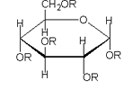
R – residue of mono-, di-, tri-, tetra-, penta-, …, polygallic acid
Gallic acid has already been studied with you earlier.
Digallic acid is formed by the simple condensation of two molecules of gallic acid via one of the –OH groups of one molecule and –COOH of the other (to construct a molecule of digallic acid, we take away –H and –OH from these two groups, respectively, that is, water). The bond formed as a result of these transformations –CO–O– is called depside, and the new molecule is a depside.
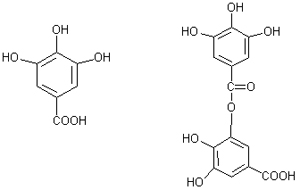
Gallic acid Digallic acid
Ellagic acid can essentially be represented as a dimer of gallic acid. Draw two molecules of gallic acid in mirror image one below the other, connect them in the center by simply drawing a line, and at the edges, that is, by the –COOH group of one molecule of gallic acid and –OH of the second, taking away H–OH (water) from each of them. This way you will obtain the formula of ellagic acid.
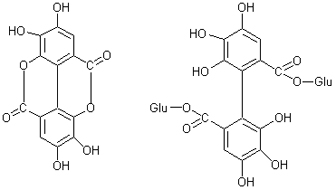
Ellagic acid Alnitannin
One of the known ellagitannins, whose structure is definitively established, is alnitannin, which is constructed even more simply. Again, we draw two molecules of gallic acid one below the other in mirror image and connect them in the center with a line. Now, in each of the –COOH groups, we replace hydrogen with a glucose residue and obtain the formula of alnitannin.
Condensed Tannins
Condensed tannins are products of the polycondensation of catechins, leucoanthocyanidins, and anthocyanidins. I remind you of their formulas.

Catechin (flavan-3-ol) Leucoanthocyanidin (flavan-3,4-diol) Anthocyanidin
Condensed tannins can form in two ways: with the opening of the heterocycle (according to K. Freudenberg) and without the opening of the heterocycle in the manner of oxidative condensation (according to D.E. Khatuey).
According to K. Freudenberg, condensation is accompanied by the opening of the heterocycle and leads to the formation of linear polymers (or copolymers) of the type “heterocycle ring, position 2 + ring A, position 6” (2 + 6). Freudenberg believed that this condensation is not an enzymatic process but a result of the influence of heat and acidic environment.
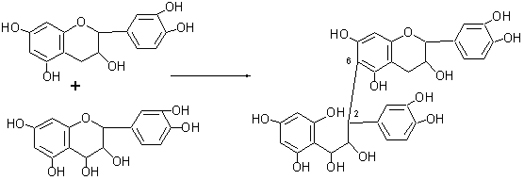
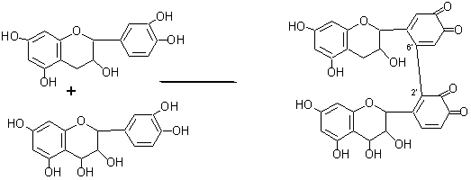
According to D.E. Khatuey, polymers are formed as a result of oxidative enzymatic condensation, which occurs in the manner of “tail to tail” or “ring B + ring B” (6’ + 2’). Such condensation occurs during aerobic oxidation of catechins and leucoanthocyanidins by polyphenol oxidases with subsequent polymerization of the resulting o-quinones.
Formation of condensed tannins according to D.E. Khatuey:
As you can see, compared to the material we have discussed earlier, mastering the formulas of tannins is child’s play. But don’t relax, let’s move on.