How to Remember the Formulas of Essential Oil Components
do not look at whom you fear!
Since the main components of essential oils are terpenoid compounds of various structures, we will start with them.
Terpenes and terpenoids are compounds that consist of isoprene units linked together “head to tail” or (less frequently) “tail to tail.” Monoterpenes contain 2 isoprene molecules, sesquiterpenes (one-and-a-half terpenes) – 3, diterpenes – 4, triterpenes – 6 (saponins, cardiac glycosides).
The isoprene molecule C5H8 has the structure CH2=C(CH3)–CH=CH2. The branched fragment of the isoprene molecule is called the “head” (i.e., CH2=C(CH3)– ), while the unbranched part is called the “tail” (–CH=CH2).
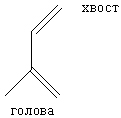
Isoprene
Acyclic and monocyclic monoterpenoids are constructed in a “head to tail” manner. There can be double bonds between carbon atoms in various locations; additional branches can extend from the carbon atom that connects the “head” and “tail”; the molecule can cyclize, but the overall structure remains.
Among acyclic monoterpenoids, you should know myrcene, ocimene, geraniol, alpha–linalool, beta–linalool, and citral. Their common feature is the absence of a closed ring (hence they are called acyclic). Their structure resembles a question mark resting on a stand, and for the overwhelming majority of acyclic monoterpenes (except beta–linalool), the “leg” of this sign is very well reinforced – it has a double bond. The difference lies in the number and position of double bonds, as well as the presence or absence of additional groups in the molecule (besides isoprene units).
Myrcene and ocimene have three double bonds; the other acyclic compounds we are considering here have two double bonds.
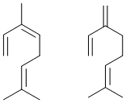
Myrcene Ocimene
In the molecule of ocimene, all three double bonds are arranged parallel, while in the molecule of myrcene, two are parallel and the third is at an angle to them.
Geraniol and linalool, based on their names, are alcohols, meaning they have –OH groups (the suffix –ol).
Geraniol can be viewed as myrcene with a water molecule attached; in this case, the double bond at the beginning of the question mark disappears, and to the –CH2 group in the myrcene molecule at this location, –OH is attached, while to the further –CH group – hydrogen is attached accordingly.
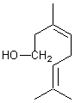
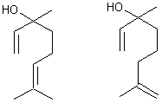
Geraniol alpha–Linalool beta–Linalool
Alpha– and beta–linalools differ from other acyclic terpenoids by the presence of an –OH group at the top of the question mark, forming what seems to be an antenna with a –CH3 group, which is present in all terpenoids.
In alpha–linalool, both double bonds are arranged parallel, unlike in beta–linalool, where they are at an angle to each other.
To remember this, one can use the following analogy. The very first position in geometry (i.e., its alpha-position, according to Euclid) stated that parallel lines do not intersect (our parallel double bonds in alpha–linalool). And only centuries later did science conclude that parallel lines can also intersect (a step forward, i.e., the beta-position, this is already according to Lobachevsky) – the possibility of intersection of double bonds in beta–linalool.
Citral is an aldehyde that has an –CHO group at the beginning of the question mark. It is not difficult to draw an analogy for citral – an aldehyde.
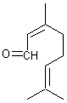
Citral
Monocyclic monoterpenoids, based on their name, have a closed hexane cycle and resemble a hut on chicken legs, which has an antenna at the top (or a television on a stand, whichever is easier for you to imagine).
The simplest structure among monocyclic monoterpenoids is mentane. It is indeed that “hut on chicken legs” or “television on a stand.” And since this compound is fully saturated, it has the suffix “–ane”.
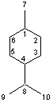
Mentane
If the mentane molecule had a double bond, we would call it mentene – such a compound also exists, and you may encounter it in textbooks. This rule applies to other saturated compounds (and not only, by the way, of terpenoid nature), for example, camphane, which we will discuss below (there is camphane, and there is camphene).
Based on mentane, menthol is constructed – an alcohol, as is clear from its name.
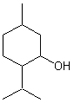
Menthol
Unsaturated monocyclic monoterpenoids include terpinene and limonene. Each of these compounds has two double bonds; the difference lies only in the arrangement of the latter.
In terpinene, the double bonds are located only in the cyclohexane ring (in the “hut” itself) and in the “antenna,” while in limonene – in the cyclohexane ring and in the “leg.”
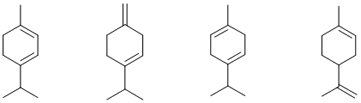
alpha–Terpinene beta–Terpinene gamma–Terpinene Limonene
Alpha–terpinene has double bonds between C1–C2 and C3–C4 atoms of the cyclohexane ring. In beta–terpinene, the double bond between C3–C4 remains, while the upper double bond migrates to the “roof,” forming a double “antenna” (C1–C7). When transitioning to gamma–terpinene, this upper double bond migrates even further counterclockwise and moves to position C1–C6; while C3–C4 again remains in place.
In the molecule of limonene, the double bonds are arranged parallel to each other: the very restless bond C1–C2, which has been migrating in terpinene, this time remains in place, while the second reinforces the “leg” on the right side (as we mentioned above).
Two more representatives of monocyclic monoterpenoids – cineoles – have a somewhat more specific structure and are oxides.
If we extend the analogy of monocyclic monoterpenes with a hut on chicken legs, then cineoles are already a remodeled hut, although still on chicken legs. In the case of 1,4–cineole, we have a “hut with a veranda,” and for 1,8–cineole (= eucalyptol) – a “hut with a courtyard.”
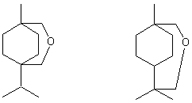
1,4–Cineole 1,8–Cineole (= Eucalyptol)
Bicyclic monoterpenoids have two condensed non-aromatic rings.
Fully saturated bicyclic monoterpenes are camphane and borneol.
Their structure resembles a banjo with one string (there is even a crossbar in the middle of the deck to better tension the string); only camphane is a typical banjo, while borneol is a modern banjo with a microphone (the role of which is played by the –OH group on the right side); you can even imagine that borneol is a banjo from Borneo.


Camphane Borneol
In the –OH group of the borneol molecule, hydrogen can be replaced by an isovaleryl group (let’s remember iridoids!), thus forming bornylisovalerate.
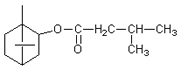
Bornylisovalerate
Based on camphane, the camphor molecule is constructed. Continuing the musical theme, camphor is a rock banjo with the most modern radio microphone (the double bond, i.e., the =O group on the side). Depending on the type of polarization plane rotation, there are two isomers of camphor: (+)–camphor – dextrorotatory, of natural origin, and (–)–camphor – levorotatory, semi-synthetic. Synthetic camphor is represented as (+) and exists as a racemate – a mixture of these two isomers.


(+)–Camphor (–)–Camphor
A separate subgroup within bicyclic monoterpenes includes compounds of the pinane type – pinenes. Pinenes resemble a banjo with a broken string (it has been played so much that a piece of the string has been torn off and laid crosswise) and has one double bond in the molecule (the suffix “–ene”).
How are they constructed? Remember terpinene. In alpha–terpinene, there was a restless double bond between C1–C2. It is also present in alpha–pinene; and it has the same lively character, migrating in beta–pinene to C1–C7 (that is, just like in terpinene).


alpha–Pinene beta–Pinene
Among sesquiterpenoids, although they are the most common group among all known terpenes, we will consider only 5 compounds from different subclasses.
Acyclic sesquiterpenes include farnesene, which can be depicted as 3 isoprene molecules connected by “head to tail” bonds:
Among monocyclic sesquiterpenoids, remember alpha–bisabolol. To construct it, add a cyclohexane ring in place of one double bond at the very beginning of the question mark to the molecule of alpha–linalool, additionally reinforcing its left part (that is, make an additional base on the left part of the cyclohexane ring – as in the question mark itself).
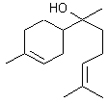
alpha–Bisabolol
Bicyclic sesquiterpenes, like their corresponding monoterpenes, have two condensed rings. These compounds differ significantly in their structure. Here we will consider chamazulene.
The structure of chamazulene externally resembles a bee – it has a “head” (a five-membered ring) and a “body” (a seven-membered ring). This “bee” has 5 stripes (double bonds located every other carbon atom); it seems to be trying to take nectar with its “proboscis” (remember, we do not mark the –CH3 group in the drawing, we just put a dash) and even leans over, bending one leg.
By the way, you can associate chamazulene with a bee in your mind if you think: “The chamazulene bee came for nectar.”
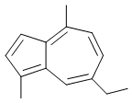
Chamazulene
Tri-cyclic sesquiterpenoids, as you may have guessed, have three condensed rings.
To construct ledol, we draw the chamazulene molecule – with a “proboscis,” but without double bonds and “legs.” We will consider ledol as a bee that has already taken off with nectar: it has spread one wing (the third cycle of the molecule – tri-cyclic), at the edge of which there are two buzzers (it doesn’t matter that in nature everything is different – since it makes it easier for us to remember, let it be this way here). The second wing is still folded, and we see only its buzzers in the drawing (indeed, with one more –OH group – amidst all these zoological musings, let’s not forget that we are considering ledol, which is an alcohol that must have an –OH group).
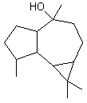
Ledol
Lastly, we will consider sesquiterpene lactones. From the name, we understand that these compounds must have a lactone ring.
To obtain the sesquiterpene lactone matricin, we will again draw “the bee that came for nectar,” that is, chamazulene, but now we leave it with only two “stripes” (= double bonds) – only in the upper part. This “bee” has 2 “proboscises”: one of them has a –OH group. Additionally, it has a “tail” formed by the –COOCH3 group, and it is kneeling on two legs, the front one of which has a kneepad (a heterocyclic O atom), and its legs are connected by “paws” (humans have handcuffs, why not have paws in the bee kingdom?). We assume that this is probably a mother bee, punished for the sins of her wayward children, and she is atoning for these sins… Well, did you remember matricin?
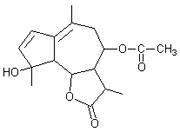
Matricin
We have one last group of essential oil components to consider – aromatic compounds – derivatives of p-cymene (thymol), phenylpropane (anethole), benzene (vanillin).
I think you won’t have major problems with these formulas.
Para-cymene (= p-cymene) – is the same mentane, in which the cyclohexane ring is replaced by a benzene one.
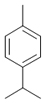
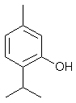
p–Cymene Thymol
Thymol is an alcohol derivative of p-cymene, that is, p-cymene with an –OH group near the “leg” (similarly to the pair “mentane – menthol”).
Anethole is a derivative of phenylpropane, that is, a compound that has 3 carbon atoms in the chain, with a phenyl radical (a benzene ring with an –OH group) attached to the end of it. It is precisely through the –OH group of the benzene ring that the modification of phenylpropane occurs during the formation of anethole – instead of hydrogen, the –CH3 group is simply attached.
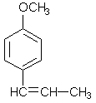
Anethole
Vanillin, the aldehyde of vanillic acid, is a derivative of benzene, so it certainly contains a benzene ring and a –CHO group. Opposite this “sleepy” (read –CHO in Russian) group is the –OH group, next to which is the –OCH3 group. If we continue to read these groups in Russian, we can form the phrase: “He is about sleep” (probably telling a story…). That is, vanillin evokes sleepy thoughts for us.
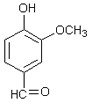
Vanillin
It is hard to believe that we have thoroughly analyzed the formulas of the main mono- and sesquiterpenoids!
A lot of complex material still lies ahead (saponins, cardiac glycosides, flavonoids, alkaloids). Let’s move on to them! We step towards saponins.