How to remember saponin formulas
Rule number four:
Live in the world with science.
How to remember saponin formulas?
Saponins are another rather difficult subject to grasp.
First, it’s important to understand that saponins are divided into triterpene and steroid types.
Second, all saponins are glycosides. The aglycone portion of saponins is called sapogenin. The sugar portion of saponins is most often glucose, galactose, xylose, or rhamnose.
You should start by memorizing the basic skeleton of the cyclopentanoperhydrophenanthrene formula (4 rings, 3 of which are six-membered and one is five-membered) and the numbering of its carbon atoms (usually this doesn’t cause much difficulty).
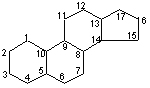
Cyclopentaneperhydrophenanthrene
A number of saponins are its derivatives. We’ll draw the cyclopentane ring with the triangular protrusion facing upward and draw “lines” at the positions С10, С13 and С14. These “lines” denote in our country (yes, and not only in our country, but very often in scientific chemical literature as well) a group СН3, which chemists agreed not to indicate in cases of complex molecules, so as not to clutter the drawing. So, the group itself СН3 It’s not necessary to label it, but a single bond must be drawn to it (as you can see in the figures of all saponin formulas).
Now let’s move on to the formulas themselves.
General rule: absolutely all triterpene saponins contain “antennae” in the position С4 (that is, two –СН3 groups).
Triterpene saponins are tetracyclic and pentacyclic.
Tetracyclic triterpene saponins have four closed conjugated rings.
To the cyclopentanoperhydrophenanthrene skeleton with additions (+ dash in С10, С13 and С14 + “whiskers” in С4) At the top of the triangular protrusion of the cyclopentane ring, we draw a “double fence with protrusions”, as some students call it. This yields the formula for lanostane.
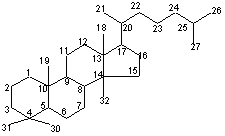
Lanostane
We connect the line that comes out of the position with a triangle С10, with the position С9 (that is, we get another small cyclic ring – cyclopropane). Everything else remains as in lanostane. This compound is called cycloartane. Cycloartane derivatives are found in milkvetch.
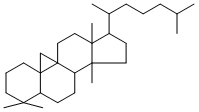
Cycloartane
If in the formula of lanostane the dash from the position С13 move to С8 (inside the cyclohexane ring), we obtain the formula of dammarane. This formula is very important because saponins—dammarane derivatives—are found in ginseng, and they are the ones that exert its adaptogenic effect.
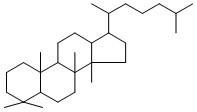
Dammarane
Remember the location of the dashes in the dammaran formula (С10, С8, С14), Because these bonds will remain in all the formulas of triterpene saponins, which you need to know.
Pentacyclic triterpene saponins have five closed conjugated rings.
The formula of lupane contains four cyclohexane rings and one cyclopentane ring. At the junction between them (rings D–E, the position С17) draw a line (remember also about the “antennae” in С4, dashes in С10, С8, С14). That is, we currently have 6 lines that will be characteristic of all pentacyclic triterpene saponins.
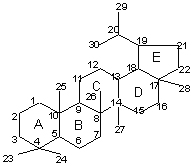
Lupane
Lupane differs from other pentacyclic triterpene saponins in that:
1) the presence of a cyclopentane ring (in all others, the fifth cyclic ring is cyclohexane);
2) the Mercedes emblem (only without the circle), emerging from the corner of the cyclopentane ring E (position С19).
Triterpene saponins—lupane derivatives—are characteristic of yellow lupine, mistletoe, and sticky alder.
The other pentacyclic triterpene saponins you need to know are derivatives of ursane or oleanane. Their molecules consist of five cyclohexane rings and have all six bars discussed above (see lupane).
Ursane was the first saponin to be isolated; it was obtained from bearberry (Arctostaphylos uva-ursi, hence the name). Alpha-amyrin is based on it. To remember this, remember that the first identified saponin was ursane; alpha is the first letter of the Latin alphabet; therefore, ursane is logically related to alpha-amyrin.
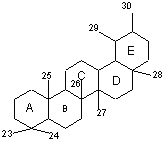
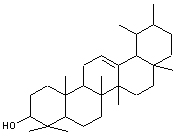
Ursane alpha-Amyrin
The second pentacyclic saponin, whose derivatives are also called amyrins, is oleanane, which was isolated from the olive tree Olea europaea, hence its name. Beta-amyrin is based on it.
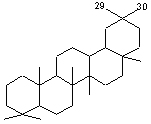
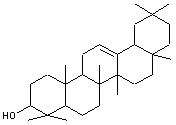
Oleanane beta-Amyrin
Ursane and oleanane derivatives make up the bulk of triterpene saponins found in plants.
Now, let’s look at their structure. They differ from each other by the presence or absence of –СН3 groups in ring E in positions С19 and С20. So, ursane has one –СН3 group both in С19 and in С20 (two parallel lines in the picture), and oleanane has two –СН3 groups in С20 (“antennae”).
Accordingly, alpha-amyrin also has two parallel lines, and beta-amyrin has “antennae”.
We’ve already memorized the alpha and beta positions in linalool molecules (remember the acyclic monoterpenoids—the components of essential oils?). Let’s review: alpha is the first letter of the Latin alphabet; parallel lines do not intersect—the first thought (our parallel lines in alpha-amyrin and ursane); beta is the second letter; the possibility of parallel lines intersecting (these are the “antennae” in beta-amyrin and oleanane)—the second thought.
Thus, ursane and oleanane molecules have 5 cyclohexane rings and 8 –СН3 groups (lines).
Alpha- and beta-amyrins are based on ursane and oleanane, respectively. Their structure also contains –ОН group in position С3 (it is to this that sugar residues are most often attached) and a double bond in the C ring between С12 and С13 atoms.
Their derivatives are ursolic and oleanolic acids (which, by the way, often cause the acidic reaction of saponin foam, which distinguishes it from soap foam, which has an alkaline reaction). The molecules of these acids are formed by the addition –СООН group in position С17 instead of a group –СН3.
Another well-known acid—a derivative of oleanane and beta-amyrin—is glycyrrhetinic acid, which is found in licorice roots. Its structure is similar to beta-amyrin, but it differs from it by the presence of a quinoid group (С=О) in position С11 and replacing one of –СН3 groups of “antennae” (namely, groups in position С30) to the acid group –СООН.
It is the presence of the С=О group in position С11 determines the hormone-like properties of glycyrrhetinic acid and licorice root (corticosteroids contain a similar group, see below, for example, cortisone).
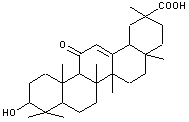
Glycyrrhetinic acid
In general, ursane derivatives are less common in the plant kingdom than oleanane derivatives. The former are found in Orthosiphon stamineus and have a diuretic effect, while the latter, as already noted, are found in licorice, as well as calendula, horse chestnut, polemonium, and aralia, and are responsible for anti-inflammatory, antispasmodic, expectorant, venotonic, capillary strengthening, and tonic properties.
Steroidal saponins also have the formula cyclopentanoperhydrophenanthrene. They are often used to synthesize steroid hormones, particularly cortisone, the formula of which you should know.
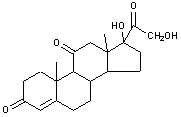
Cortisone
Unlike triterpene saponins, steroids and steroidal saponins do not have –СН3 groups (lines) directed downwards, but they are directed only upwards. Thus, cortisone contains 2 such groups – in positions С10 and С13. In addition, it has two more quinoid groups (С=О) in the cyclohexane rings themselves in positions С3 and С11, and another one – in the branched “antennae” that extends from С17 (where the “fence” is located in tetracyclic triterpene saponins). As you probably guessed, if we are talking about one “antenna”, then there must be a second one, which also extends from С17, but it ends not with –СН3 group, but with a group –ОН. By the way, the branched “antennae” also ends –ОН a group, but not an independent one, but as part of a group –СН2ОН.
Regarding monodesmosides and bidesmosides, which represent the structure of steroid saponins, they contain 3 –СН3 groups (dashes) directed upwards – in positions С10, С13 and С18. This last bond is located in a new heterocyclic ring, absent from all the other compounds we have considered so far – the 5-membered lactone ring E. However, the structure of monodesmosides is not limited to the lactone ring alone. They have another lactone ring – a 6-membered one (ring F), which seems to lie on its side and with its “nose” touches the upper right corner of the 5-membered heterocyclic ring, and on the opposite side has a “tail” (that is, again –СН3 group).
In addition, both mono- and bidesmosides have an –OH group at position С3, to which sugar residues readily attach (as is also characteristic of cardiosteroids and triterpene saponins), and a double bond between atoms С5 and С6 of cyclohexane ring B.
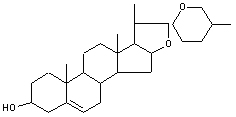
Diosgenin
Thus, we have described the structure of the main monodesmoside, diosgenin. It is found in the rhizomes of Dioscorea nipponica and other Dioscorea species, which is where the first part of the name “diosgenin” comes from. The second part indicates the aglycone nature of the compound.
Diosgenin is the basis for its glycoside, dioscin, which contains three sugar residues at position С3: one glucose molecule, to which two rhamnose molecules are attached.
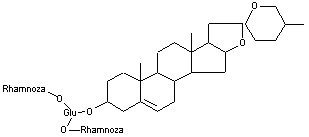
Dioscin
In bidesmosides, the 6-membered heterocyclic ring opens with the corresponding formation of aglycone or glycosides, in which sugar residues are not added in С3 position, as in monodesmosides, but on an open ring instead of a hydrogen atom in the –OH group.
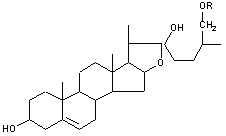
Bidesmoside (R=H or Glu)
Steroidal saponins, found in Dioscorea, Tribulus terrestris, and fenugreek, have an anti-cholesterolemic effect and serve as a raw material for the production of corticosteroids.
If you’ve successfully mastered this challenging material, congratulations! You’ve taken the second significant step toward mastering pharmacognosy. Now you know some things, including complex material. But much more lies ahead. Don’t relax!