Paracelsus
 “The power of the mind is the only limit”
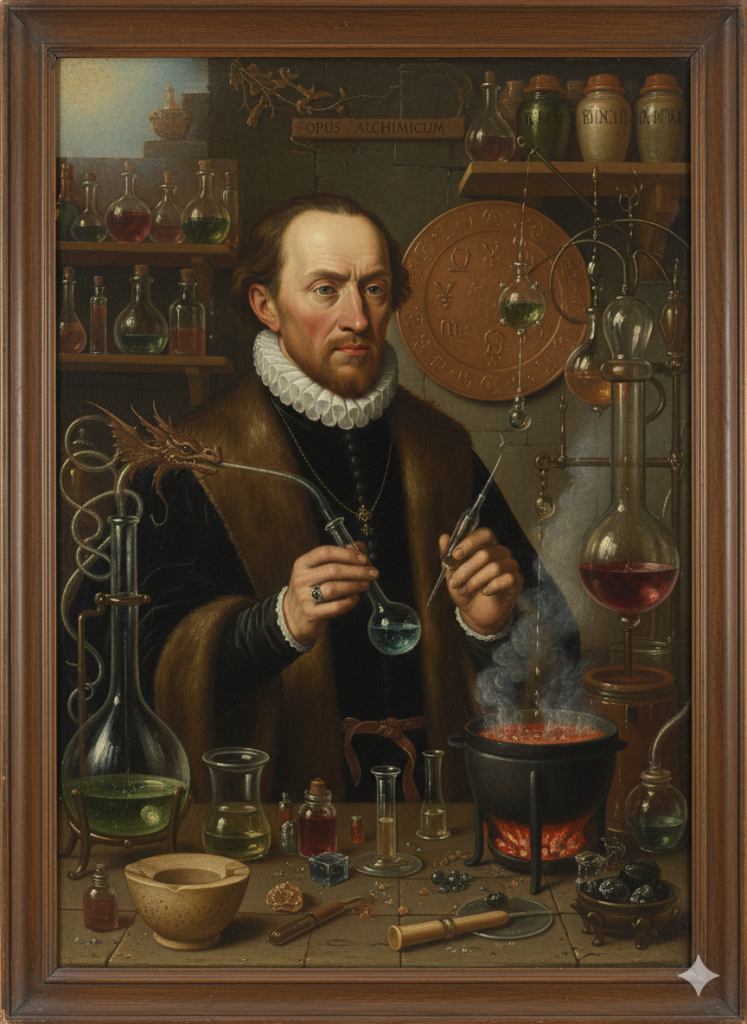 “All is poison and all is medicine;
the dose determines both”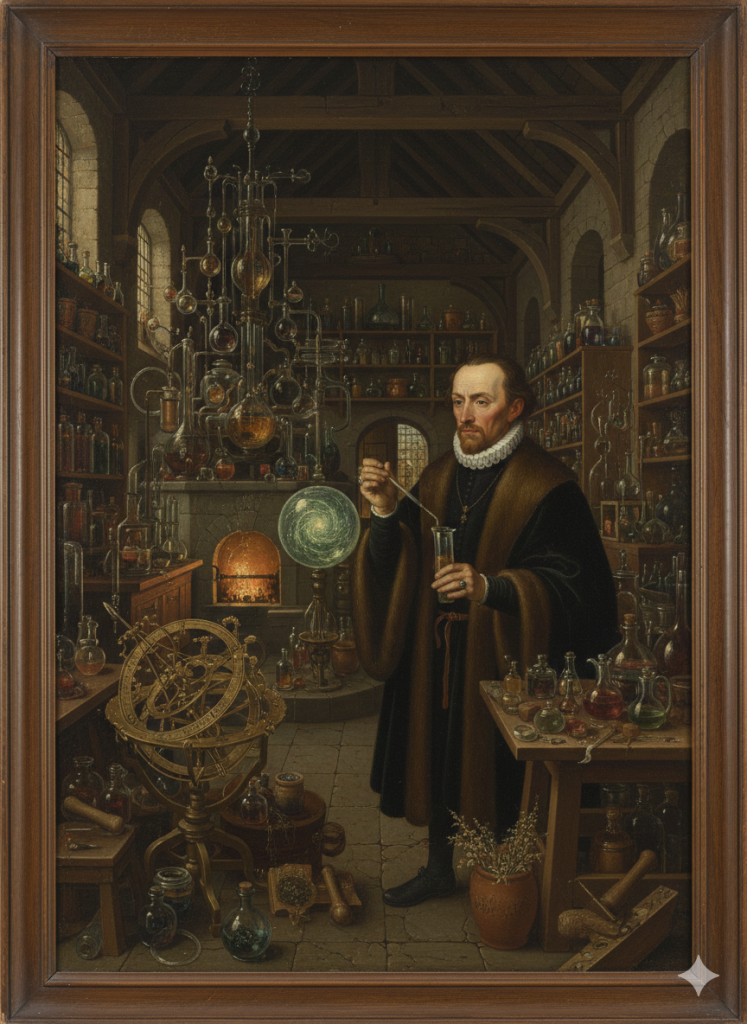 “A doctor’s theory is experience.
No one becomes a doctor
without experiments and practice”
(November 10, 1493 – September 28, 1541). 48 years
He was born in the Swiss town of Einsiedeln on November 10, 1493, to a physician from an ancient but impoverished noble family and a nurse working in the abbey.
Upon seeing her offspring, his mother was horrified: he was hunchbacked, with a huge head and a tiny body. The infant was born at a time when the sun was in the sign of Scorpio, which meant that according to his horoscope, he was destined to become a physician or an alchemist. Therefore, his name was chosen accordingly – Theophrastus in honor of the famous student of Aristotle, the physician Theophrastus.
In his youth, Paracelsus traveled almost all of Central Europe. In 1526, he was invited as a professor and city physician to the University of Basel.
He lectured in German rather than Latin, which was an unheard-of audacity at the time, becoming a decisive innovator and a fierce opponent of the old medicine, to the extent that he publicly burned the works of Galen and Avicenna.
His lectures attracted numerous listeners and brought him loud fame, but at the same time, his sharp and rude outbursts created many enemies among physicians and pharmacists. Therefore, after a year and a half of teaching, he had to leave Basel and resume his previous wandering life.
For several years, Paracelsus wandered through Alsace, Germany, and Switzerland, even visiting the semi-wild Prussia, Poland, and Lithuania, and finally settled in Salzburg, where he found a powerful patron in the archbishop and count palatine of the Rhine.
Paracelsus’s character combined an original mixture of nobility and audacity, bright intellect and gross superstition. It was said of him that he could grow precious stones and pearls in retorts, make gold and the elixir of youth, and travel through the air on a flying horse. It was rumored that a malevolent spirit was bound in the hilt of his sword. His admirers called Paracelsus “the teacher whom God placed in the invisible school established in heaven,” while his enemies labeled him “a monstrous sorcerer, a superstitious blasphemer, a vile deceiver, a drunkard, and a monster.” He himself called himself “the holy doctor.”
Paracelsus became the founder of spagyrics – a distinct branch of chemical and pharmaceutical practice centered on the art of “separating and recombining” natural substances. Unlike traditional herbalism, spagyrics involved the deep processing of plant raw materials through fermentation, calcination, and distillation. The objective of this process was to isolate the “quinta essentia” (quintessence) – the most potent active principle, purified from ballast impurities. This approach laid the fundamental groundwork for modern extraction technology and phytopreparation.
“Reading has never made anyone a physician. Medicine is an art, and it requires practice. When I began to study my art, I imagined that there was not a single Teacher in the world capable of teaching me, and that I had to grasp it myself. The book I studied was the book of nature, written by the hand of the Lord.”
Paracelsus himself wrote 230 books on philosophy, 40 books on medicine, 12 on politics, 7 on mathematics and astronomy, and 66 dedicated to the secret arts.
On September 28, 1541, Paracelsus met his end in Salzburg. The circumstances of his death remain unclear, but the latest research confirms the version of his contemporaries, according to which Paracelsus was treacherously attacked during a banquet by bandits hired by one of the physicians – his enemies – and as a result of falling on a stone, he fractured his skull, which led to his death a few days later.
“Death is nothing more than simply the end of daily work, the disappearance of air, the evaporation of balm, the extinguishing of light,” he wrote shortly before his death. With all due pomp, the body of the doctor was laid to rest in the Salzburg cemetery of St. Sebastian.
The German physician S.T. von Semmering examined Paracelsus’s skull, which, due to its unusual structure, cannot be confused with any other, and noted a crack running through the temporal bone (the skull had often been touched, and over time it had increased and become clearly visible). He is convinced that such a crack could have only arisen during Paracelsus’s lifetime, as the bones of a hard but old and dried skull could not be separated in such a manner.
After Paracelsus’s death, his books began to be published in huge editions. In 1941, the Swiss Society of Paracelsus was founded in the doctor’s homeland of Einsiedeln, in which Carl Gustav Jung also participated. And in Villach, the highest award for a scholar is still considered the “Ring of Paracelsus.”
Theophrastus von Hohenheim is the founder of iatrochemistry – the predecessor of modern pharmaceutical chemistry.
“Chemistry,” said Paracelsus, “is one of the pillars on which the science of medicine must rest. The task of chemistry is not to make gold and silver, but to prepare medicines.”
Paracelsus’s ideas about the active “principles” contained in plants contributed in the future (17th–18th centuries) to the development of research on the chemical composition of medicinal plants. This opened a new page in pharmacognosy – the page of phytochemistry.
In Paracelsus’s time, the doctrine of signatures was popular, the essence of which was to assign a plant for medicinal purposes based on the peculiarities of its external characteristics (from Latin signa naturae – signs of nature). Based on these ideas, plants with bright yellow flowers (for example, immortelle) were used for jaundice, the thorny plant thistle was used for stomach colic and to ward off “unclean forces,” and the resemblance of ginseng and mandrake roots to the shape of a human gave grounds to consider them a panacea for all diseases.
Paracelsus’s favorite medicinal plant was St. John’s wort, which was used against ghosts and spirits hostile to humans, in the treatment of puncture wounds. “The veins on its leaves are signatures. If they are punctured, it means that this plant drives away all ghosts around a person… St. John’s wort is almost a unique remedy,” wrote Paracelsus.
Despite the false premises and mystical notions, the signature theorists contributed to the accumulation of morphological and systematic knowledge, which in the future played a significant role in the development of plant systematics and diagnostic sections in pharmacognosy.
From the letters of E.I. Rerikh: “A person, knowing the characteristics (i.e., shape, smell, appearance) of a plant, could use it for medicinal and other purposes without the need for ‘blind experiments and accidental discoveries.’ The same applies to the mineral and animal kingdoms. This is the science of ‘Correspondences.’ And since all nature is built according to a certain plan, the researcher with open eyes will see these ‘correspondences’ in everything. Paracelsus knew this science. His wonders were the result of applying these principles.”
Paracelsus’s most famous phrase: “All is poison, and nothing is without poisonousness; only the dose makes a thing not a poison” (in popular paraphrase: “All is poison and all is medicine; the dose determines both”).
Paracelsus’s aphorism: “What is considered mysticism in one century becomes scientific knowledge in another.”