How to Remember the Formulas of Anthraquinone Derivatives
Hide your crumpled cheat sheets!
How to remember the formulas of anthraquinone derivatives?
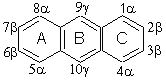
Anthracene
Anthraquinone contains two quinonoid groups (C=O); anthrone – one, and instead of the second – two hydrogen atoms, meaning it is a partially reduced compound compared to anthraquinone. If one of these hydrogen atoms migrates through the system of benzene rings and reduces the quinonoid group (thus, replacing it with a –OH group), anthranol is formed (the suffix –ol indicates the alcohol nature of the compound).
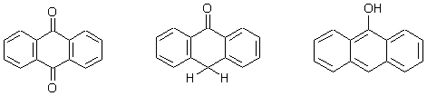
Anthraquinone Anthrone Anthranol
The difference between the derivatives of alizarin and emodin lies in the positioning of the –OH groups. In alizarin and its derivatives, the –OH groups are located in the same benzene ring, while in emodin and its derivatives – in different ones.
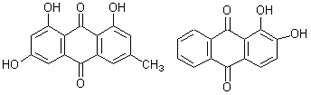
Emodin Alizarin
(= Frangulaemodin)
From the derivatives of emodin (= frangulaemodin), you need to know: aloe-emodin, hypericin, and glycosides – sennosides A and B, frangularoside, glucofrangulins A and B, frangulins A and B; from the derivatives of alizarin – ruberythric acid.
Aloe-emodin can be considered an isomer of emodin, in which the –OH group from position C6 migrates to the –CH3 group in position C3, exchanging with one of the hydrogen atoms of this group, which, accordingly, moves to C6.
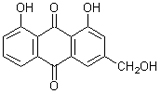
Aloe-emodin
Hypericin is a condensed compound formed by two molecules of emodin linked by two single and one double bonds.
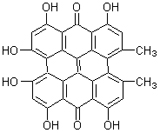
Hypericin
Sennosides A and B are represented by one structural formula – they are stereoisomers that are derivatives not only of emodin but also of anthrone. Alternatively, they can be viewed as dimeric glycosylated derivatives of anthrone, having acidic characteristics (two –COOH groups). Their aglycone (the dimer of rein, called direin) has –OH groups located in different benzene rings – A and C – of both the upper and lower monomer (as in emodin), and upon glycoside formation, one of these –OH groups of each monomer is glycosylated (that is, glucose is attached instead of one hydrogen atom).
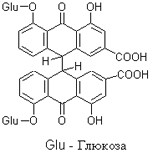
Sennosides A and B (stereoisomers)
Frangularoside is a reduced compound (a derivative of anthranol) found in the fresh bark of buckthorn and causes stomach pain, nausea, and vomiting. It is a diglycoside formed by the attachment of two monosaccharide molecules – rhamnose and glucose – to the aglycone part. Upon prolonged storage (about 1 year) at room temperature, frangularoside oxidizes with oxygen from the air and converts into the diglycoside of emodin – glucofrangulin A. Another option for the oxidation of frangularoside is heating at 100oC for one hour. Under these conditions, glucofrangulin A is also formed, but its second tautomer, in which glucose migrates to the –OH group in the upper position (C8), from which hydrogen moves to the rhamnose molecule residue, restoring it. Upon subsequent storage or under the influence of temperature, the glucose molecule is cleaved from glucofrangulin, forming a monoglycoside – rhamnoside of emodin, called frangulin A.
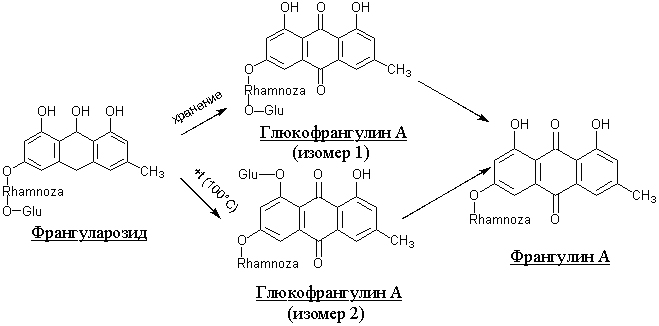
Glucofrangulin B differs from glucofrangulin A in that instead of a rhamnose molecule, it contains another sugar – apiose. The same difference exists between the molecules of frangulin B and frangulin A.
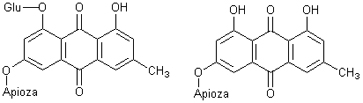
Glucofrangulin B Frangulin B
Apiose is a pentose that has a branched structure. That is, unlike other sugars you already know, the heterocyclic ring of apiose has two –CH2OH groups branching off. Moreover, the ring of this sugar is a lactone tetracyclic.
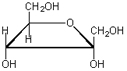
Apiose
Ruberythric acid, a disaccharide (in other words, a biozide), is a derivative of alizarin in which the hydrogen of the –OH group in the C2 position of the alizarin molecule is replaced by two sugar residues – xylose and glucose.
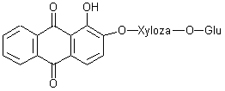
Ruberythric acid
The molecule of xylose is very easy to remember if you know the molecule of glucose. Instead of the –CH2OH group in the glucose molecule, you write –H and get the molecule of xylose (the difference between the alpha– and beta–forms, I believe you have learned forever).
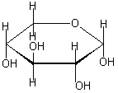
Xylose (alpha–form)
Ruberythric acid, although not an acid in the true sense of the word (acidic groups are absent), has acidic properties, which is why it has such a name.