How to Remember Chromone Formulas

     Rule eleven –
     do not be haughty
         make way.

How to remember the formulas of chromones?
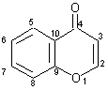
  Chromones are derivatives of 9,10–benzogamma–pyrone. The Latin letter “gamma” indicates that the carbonyl group is located opposite the heteroatom of oxygen (in the para position).

   hromon

  9,10–Benzogamma–pyrone (= Chromone)

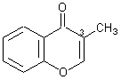
  Among simple chromones, 3-methylchromone can be noted, constructed according to its name.
   metilhromon

  3-Methylchromone

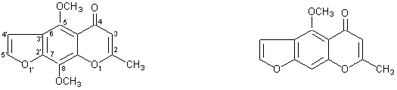
  In furanochromones, the furanose ring is attached linearly. It is unsaturated, like in furanocoumarins, meaning it has one double bond. This is the most common subgroup of chromones, from which you need to know kellin and visnagin.
 furanohromon  

Kellin                                                     Visnagin
 
  Kellin has two methoxy groups –OCH3, located opposite each other in the benzene ring (positions C5 and C8), and one methyl group at position C2 of the pyranose ring.
  If one methoxy group (at C8) is removed from kellin, we obtain visnagin. The name “visnagin” is very easy to confuse with visnadin, which, as we have already mentioned, belongs to coumarins. Remember that one of the most well-known sources of chromones (and specifically chromones!) is Visnaga daucoides Gaertn. (family Apiaceae), which contains visnagin. The coumarin visnadin is also found in Visnaga daucoides, but it is not the main compound. Knowing this will help you somewhat simplify the assimilation of chromones (draw an analogy: visnaga – visnagin).
 
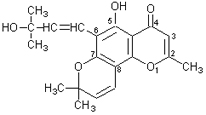
  Regarding pyranochromones, you just need to know their structure. Obviously, you have already understood that they must have a pyranose ring. The pyranose ring is attached angularly, and it is unsaturated (has a double bond). Very often, two methyl groups are attached to the carbon atom adjacent to the heteroatom of oxygen in this pyranose ring (which is also characteristic of pyranocoumarins).
  Among individual pyranochromones, remember sorbifol, found in the leaves of rowan Sorbus aucuparia L., as is clear from the name (sorbus folium). We provide its formula as an example; it is not mandatory to memorize for our department (unlike all other formulas discussed earlier).
   sorbifol

  Sorbifol

  Benzochromones contain a benzene ring attached angularly. One of the benzochromones is eleutherinol (source – the plant Eleutherococcus senticosus, family Iridaceae) – it contains two –CH3 groups (at positions C2 and C5 of the chromone skeleton) and two –OH groups, located in the meta position in the benzene ring.
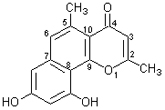
eleuterinol

  Eleutherinol

Similar Posts

  • Blueberry

    BLUEBERRY     The fruits of the blueberry (Vaccinium corymbosum) exhibit a relatively limited vitamin profile, with the exception of ascorbic acid (46.9% of the Daily Value [DV] per 100 g) and vitamin K (phylloquinone) (16.1%). Contrary to popular misconceptions, these fruits are characterized by a low carotenoid concentration, specifically in regard to lutein and…

  • Kohlrabi

    KOHLRABI CABBAGE      Kohlrabi cabbage (Brassica oleracea var. gongylodes) is characterized by a significant concentration of ascorbic acid (71.0% of the Daily Value [DV] per 100 g). Its mineral profile is notably rich in: silicon (236.0% DV per 100 g), boron (143.0%), potassium (15.0%), molybdenum (14.3%), and copper (13.2%). The carbohydrate fraction consists primarily…

  • Lead: A Hematopoietic Pollutant

             Lead (= Plumbum) (Pb)          Hematopoietic pollutant               Lead is a carcinogen and teratogen for the human body. However, literature contains data confirming that it is essential for life, as it affects protein synthesis, cellular energy balance, and genetic machinery, and participates in the metabolic processes…

  • Asparagus

    ASPARAGUS      Asparagus (Asparagus officinalis) is characterized by a balanced profile of vitamins and minerals. Notably, it exhibits a high concentration of methylmethioninesulfonium chloride (vitamin U): containing 110.0% of the Daily Value [DV] per 100 g. Other significant vitamins include phylloquinone (35.0%), folate (13.0%), the carotenoids lutein and its isomer zeaxanthin (11.8%), beta-carotene (9.0%),…

  • Horseradish

    HORSERADISH      The storage roots of horseradish (Armoracia rusticana) exhibit a high concentration of vitamins, mineral elements (containing nearly all essential macronutrients and 9 micronutrients in significant quantities), essential and non-essential amino acids – specifically arginine (26.2% of the Daily Value [DV] per 100 g) and proline (11.3%) – omega-3 polyunsaturated fatty acids (26.7%,…

  • Arugula

    ARUGULA (indau, eruca sativa)       Arugula stands out for its vitamin K (phylloquinone) content (90.5% of the daily requirement in 100 g), lutein and its isomer zeaxanthin (59.3% respectively), beta-carotene (28.5%),folic acid (24.3%), vitamin C (ascorbic acid) (21.4%), and pantothenic acid (8.8%).     The mineral composition of arugula is very balanced, it…