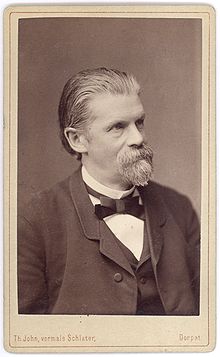
Dragendorf Georgiy Ludwigovich
 “The search for alkaloids in a plant
is not merely a chemical test,
but the revelation of the active power
that defines its medical value” “A pharmacognosist must see
through the plant tissue, isolating
the pure substance where nature
has created a complex labyrinth”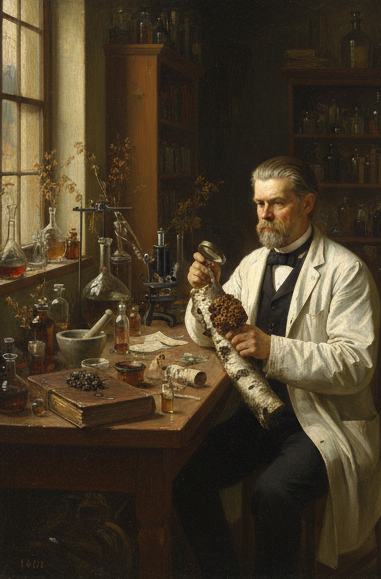 “In phytochemistry, there are no trifles – every grain of knowledge serves life”
Georg Ludwig Dragendorff (Johann Georg Noel)
(1836–1898). 62 years
Born on April 20, 1836, in Rostock (Northern Germany) into the family of a physician, a privat-docent at Rostock University. After graduating from high school in 1853, G.L. Dragendorff served in Rostock as an apprentice in the pharmacy of Dr. Witte, and in 1856 passed the examination for the title of pharmacy assistant. In the same year, he entered Rostock University, and in 1858 passed the examination for the title of first-class pharmacist, after which he simultaneously worked and studied in Heidelberg.
In 1860, he returned to Rostock University, where he studied chemistry and natural sciences, and almost immediately obtained a position as an assistant at the chemical institute of this university. From 1861, he was a privat-docent at Rostock University.
In 1861, he defended his dissertation for the degree of Doctor of Philosophy: “On the Influence of Phosphorus on the Salts of Carbonic and Boric Acids” (degree awarded in 1862), and in 1862, at the invitation of the St. Petersburg Pharmaceutical Society, he came to Russia.
G.L. Dragendorff was also responsible for conducting forensic chemical examinations for the St. Petersburg Medical Administration. In the course of this work, he improved methods for analyzing poisons, particularly alkaloids, laying the foundations for further toxicological, forensic-chemical, and phytochemical research.
At the same time, G.L. Dragendorff taught pharmacognosy and pharmacy at the school associated with the pharmaceutical society, giving lectures on chemistry and methods for quality control of medicinal products to pharmacy workers.
In 1864, at the University of Dorpat (Yuriev, now Tartu), he defended his dissertation for the degree of Master of Pharmacy: “Chemical Studies on a Fungus Found on Betula alba and Related Species,” and in December 1864, he was elected an ordinary professor of pharmacy and appointed director of the first Pharmaceutical Institute in Russia at Dorpat University.
He held this position for 30 years, transforming the institute into a model educational institution.
G.L. Dragendorff was known as an excellent lecturer. Scholars from many countries studied under him (supervisor of more than 70 doctoral and master’s theses). Under his guidance, one of the first urban sanitary laboratories in Russia was established in Dorpat.
At the same time, G.L. Dragendorff held managerial positions at Dorpat University: from 1883 to 1887 – prorector, from 1888 to 1892 – dean of the medical faculty; from 1875 to 1890 – secretary, and from 1890 to 1893 – president of the Society of Naturalists at the university.
In 1894, he retired and returned to Rostock.
G.L. Dragendorff’s personal life was happy. In 1868, he married Sophia, née Spon, and later became the father of four sons, who also dedicated themselves to science: Johannes – professor of archaeology at Freiburg University, Otto – professor of anatomy at Greifswald University, Ernst – historian in Rostock, Kurt – Doctor of Chemistry in Rostock.
G.L. Dragendorff died on March 26, 1898, in Rostock, where he is buried.
A monument to G.L. Dragendorff was erected at his grave in 1901 at the expense of his students, created by sculptor A. Weitzenberg. A bronze bas-relief of G.L. Dragendorff was installed in Tartu (in 1982, unveiled during the celebration of the anniversary of Tartu University). A commemorative medal was issued for the 150th anniversary of G.L. Dragendorff’s birth (1986).
G.L. Dragendorff’s experimental research focused on the chemistry of birch fungus, salep tubers, spores, aconite, and other plants of the northern strip of Russia. He conducted numerous studies on the examination of laxatives (senna, rhubarb, aloe, jalapa).
G.L. Dragendorff can be considered a pioneer of phytochemistry. He developed a methodology for studying medicinal plant raw materials and in 1882 wrote a manual “Qualitative and Quantitative Analysis of Medicinal Plants” (Ger. “Die qualitative und quantitative Analyse von Pflanzentheilen”). He was interested in the phylogenetic relationships of plants with their chemical composition. A series of articles on the topic “The Relationship Between Chemical Components and Botanical Features of Plants,” published in 1879 in the “Pharmaceutical Journal of Russia,” should be regarded as perhaps the first works dedicated to this important issue.
He devoted much time to studying medicinal plants of folk medicine in Turkestan, Tibet, China, Africa, and collected one of the largest collections of medicinal raw materials in Europe at the Pharmaceutical Institute.
G.L. Dragendorff’s main legacy for domestic pharmacy can be considered his famous reference book “Medicinal Plants of Various Peoples and Times, Their Uses, the Most Important Chemical Substances, and History” (1890). This reference book, which provides information on approximately 1200 species of medicinal plants, is still often a starting source for studying medicinal plants of various countries and peoples.