White mushrooms, Porcini (Boletus edulis)
Cultivation possibilities: Cultivation of porcini mushrooms on an industrial scale is extremely difficult due to their mycorrhizal nature (the need for a connection with the root system of a living tree). However, there are successful practices of semi-cultivated cultivation in private farms by infecting the roots of young trees with mycelium.
Basic information about the chemical composition
Patients with gout should consider that the total purine content in white mushrooms constitutes 27.0% of the maximum daily allowance per 100 g.
White mushrooms contain a significant quantity of phytosterols (126.7% DV per 100 g), with ergosterol (82.7%) being the primary component. Ergosterol modulates hepatic enzymes, facilitates detoxification processes, and supports the normalization of liver function.
The oxalic acid content per 100 g is negligible (2 mg), representing 0.5% of the maximum tolerable daily intake (for further details, see Rhubarb).
It should be noted that white mushrooms possess the capacity to accumulate the toxic ultratrace element cadmium (28.0% DV per 100 g).
⚠️ Beware of poisonous doppelgangers!
Main Doppelganger: Satanic Mushroom (Rubroboletus satanas).
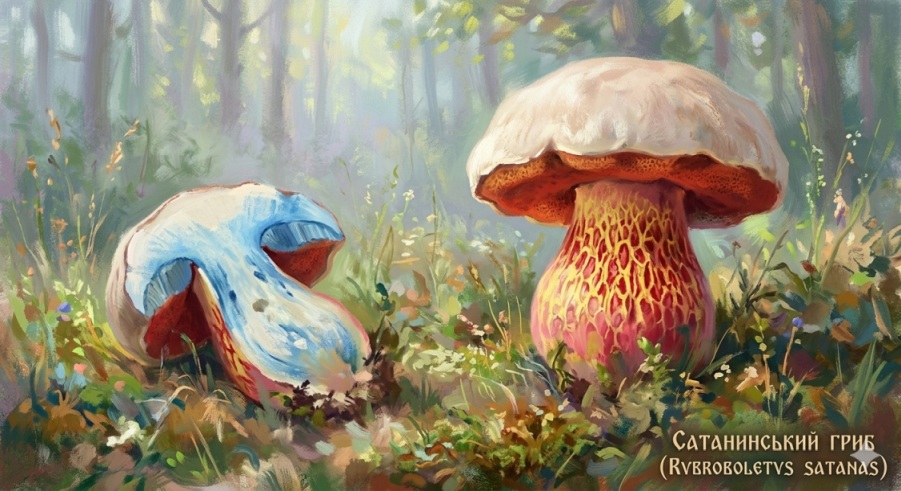
Color change: The flesh of the white mushroom always remains white. In the satanic mushroom, the flesh slowly turns blue or reddish on the cut.
Hymenophore: In the white mushroom, the tubular layer is white, yellow or greenish. In the satanic mushroom, the pores of the tubular layer are bright red or orange-red.
Leg: In the satanic mushroom, the leg has a pronounced thick red mesh, while in the white mushroom, the mesh is light (whitish) and usually only in the upper part of the leg
Doppelganger: Bitter mushroom / Bile mushroom (Tylopilus felleus).
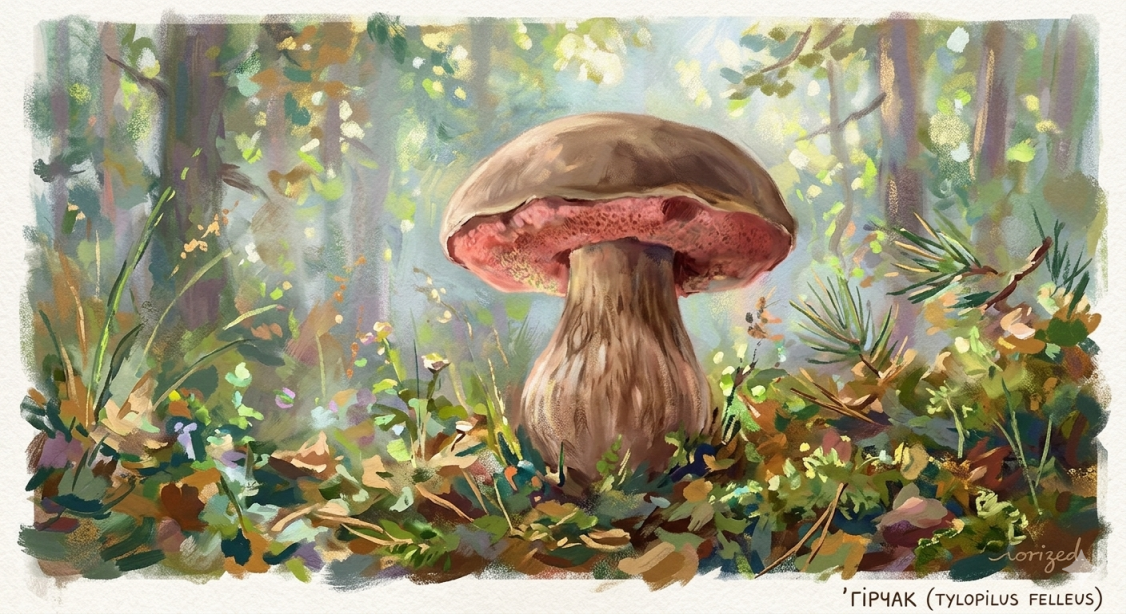
It has a pink, tubular core and a very bitter taste. When cut, the flesh turns slightly pink.
|
The Poisonous Doppelganger |
Toxin type / Syndrome |
First aid and antidote |
|---|---|---|
|
The Satanic Mushroom (Rubroboletus satanas) |
Causes acute gastroenteritis due to the presence of local irritants (e.g., muscarine in the death cap mushroom). Symptoms: Nausea, severe vomiting, and diarrhea, which develop 1–3 hours after ingestion. First aid: Gastric lavage with plenty of water, sorbents, restoration of water and electrolyte balance (rehydration). |
There are no specific antidotes; treatment is symptomatic. Gastric lavage, sorbents. Symptomatic treatment. |
|
Bitter mushroom / Bile mushroom (Tylopilus felleus) |
Causes acute gastroenteritis due to the presence of local irritants. Symptoms: Nausea, severe vomiting, and diarrhea, which develop 1–3 hours after ingestion. First aid: Gastric lavage with a large amount of water, sorbents, and restoration of fluid and electrolyte balance (rehydration). |
There are no specific antidotes; treatment is symptomatic. Gastric lavage with copious amounts of water, sorbents, and restoration of fluid and electrolyte balance (rehydration) |
If you have even the slightest doubt about a mushroom – don’t put it in your basket!
WHITE MUSHROOMS (PORCINI)
Water per 100 g: 89.4-92.45 g
Ash per 100 g: 0.9 g
CHEMICAL COMPOSITION
Vitamins, macro- and microelements, nutrients per 100 g
VITAMINS


* Full pitcher – 100% of daily norm; empty – 0-1% of daily norm.
Macroelements


PURINE BASES
Standard cup: 250.0 g of Porcini mushrooms
Faceted glass: 200.0 g of Porcini mushrooms
Teaspoon: 7.0 g of Porcini mushrooms
Tablespoon: 20 g of Porcini mushrooms