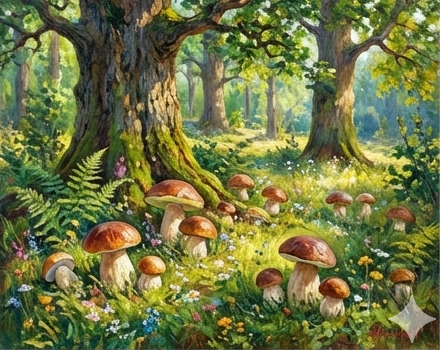
White mushrooms, Porcini (Boletus edulis)

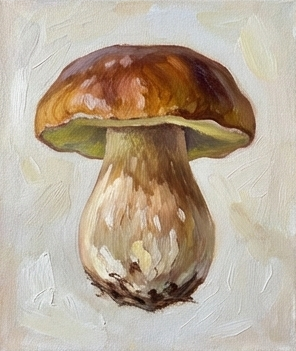
Botanical description and biological features: The white mushroom, or boletus, belongs to the Boletaceae family. Its characteristic feature is a massive cap (diameter from 7 to 30 cm), the color of which varies from light brown to dark brown. The hymenophore (the lower layer of the cap) in young mushrooms is white, becoming yellowish or olive with age. The pulp is dense, white, does not change color on the cut, which is an important diagnostic feature.
Distribution and ecology: This is a mycorrhizal fungus that enters into symbiosis with many species of trees: pine, spruce, oak, beech. It prefers forests with moderate humidity and sandy or loamy soils. In Ukraine, it is widespread, but the largest populations are concentrated in the Carpathians, in Polesie and in the forest-steppe zone.
Cultivation possibilities: Cultivation of porcini mushrooms on an industrial scale is extremely difficult due to their mycorrhizal nature (the need for a connection with the root system of a living tree). However, there are successful practices of semi-cultivated cultivation in private farms by infecting the roots of young trees with mycelium.

Basic information about the chemical composition

White mushrooms (Agaricus spp.) are characterized by a high concentration of ascorbic acid (42.9% of the Daily Value [DV] per 100 g), pantothenic acid (42.0%), and nicotinic acid (30.3%). The mineral profile is dominated by: silver (285.7% DV per 100 g), vanadium (78.0%), cobalt (60.0%), copper (32.0%), cadmium (28.0%), rubidium (26.0%), gallium (22.0%), potassium (18.7%), selenium (17.0%), chromium (12.0%), manganese (11.5%), and phosphorus (11.1%). They also contain germanium (2.5%), while starch, sucrose, and maltose are absent from their composition.

     Patients with gout should consider that the total purine content in white mushrooms constitutes 27.0% of the maximum daily allowance per 100 g.

     White mushrooms contain a significant quantity of phytosterols (126.7% DV per 100 g), with ergosterol (82.7%) being the primary component. Ergosterol modulates hepatic enzymes, facilitates detoxification processes, and supports the normalization of liver function.

     The oxalic acid content per 100 g is negligible (2 mg), representing 0.5% of the maximum tolerable daily intake (for further details, see Rhubarb).

     It should be noted that white mushrooms possess the capacity to accumulate the toxic ultratrace element cadmium (28.0% DV per 100 g).

⚠️ Beware of poisonous doppelgangers!

Main Doppelganger: Satanic Mushroom (Rubroboletus satanas).
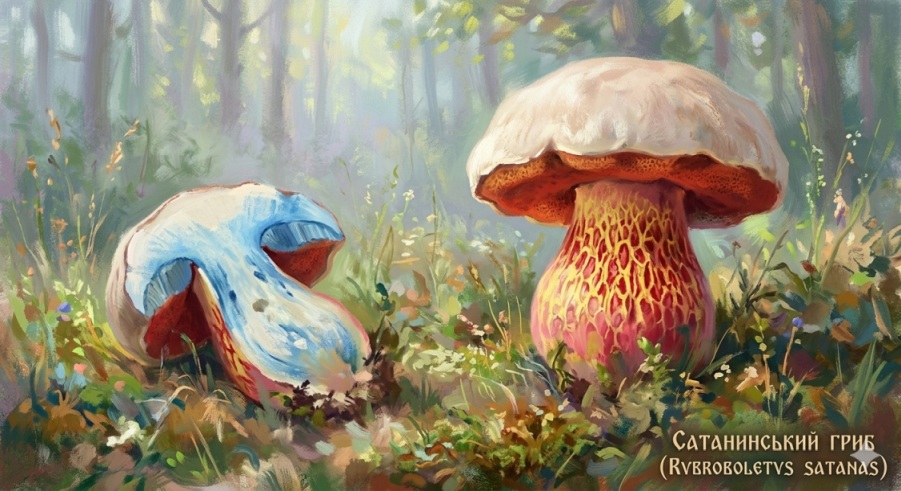
What makes it different:
Color change: The flesh of the white mushroom always remains white. In the satanic mushroom, the flesh slowly turns blue or reddish on the cut.
Hymenophore: In the white mushroom, the tubular layer is white, yellow or greenish. In the satanic mushroom, the pores of the tubular layer are bright red or orange-red.
Leg: In the satanic mushroom, the leg has a pronounced thick red mesh, while in the white mushroom, the mesh is light (whitish) and usually only in the upper part of the leg

Doppelganger: Bitter mushroom / Bile mushroom (Tylopilus felleus).
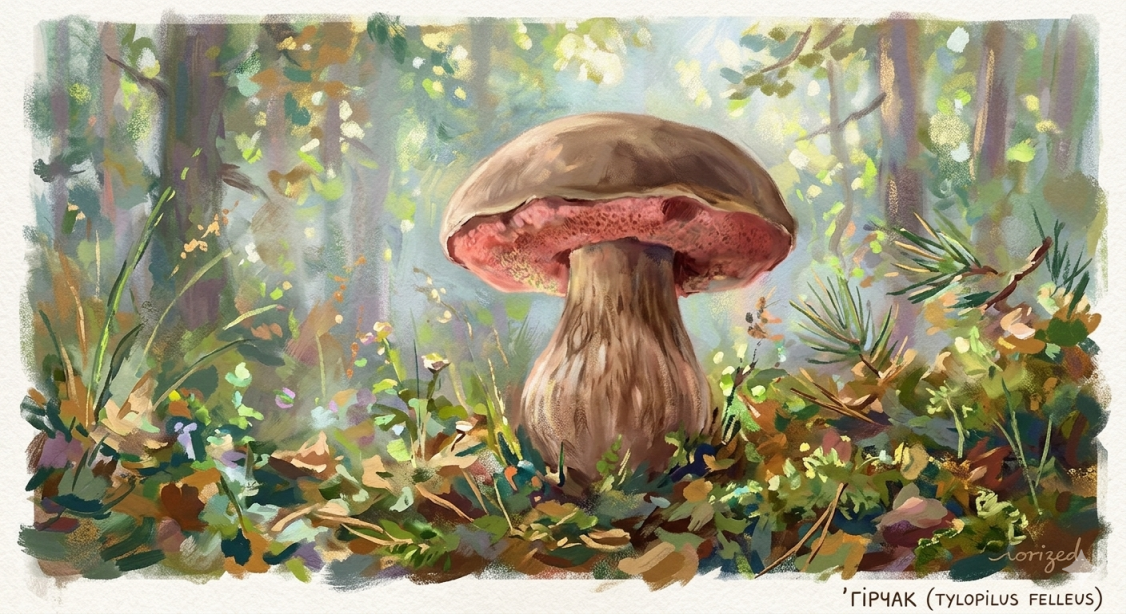
How it differs:
It has a pink, tubular core and a very bitter taste. When cut, the flesh turns slightly pink.

The Poisonous Doppelganger

Toxin type / Syndrome

First aid and antidote

The Satanic Mushroom (Rubroboletus satanas)

Causes acute gastroenteritis due to the presence of local irritants (e.g., muscarine in the death cap mushroom).

Symptoms: Nausea, severe vomiting, and diarrhea, which develop 1–3 hours after ingestion.

First aid: Gastric lavage with plenty of water, sorbents, restoration of water and electrolyte balance (rehydration).

There are no specific antidotes; treatment is symptomatic.

Gastric lavage, sorbents. Symptomatic treatment.

Bitter mushroom / Bile mushroom (Tylopilus felleus)

Causes acute gastroenteritis due to the presence of local irritants.

Symptoms: Nausea, severe vomiting, and diarrhea, which develop 1–3 hours after ingestion.

First aid: Gastric lavage with a large amount of water, sorbents, and restoration of fluid and electrolyte balance (rehydration).

There are no specific antidotes; treatment is symptomatic. Gastric lavage with copious amounts of water, sorbents, and restoration of fluid and electrolyte balance (rehydration)

If you have even the slightest doubt about a mushroom don’t put it in your basket!


WHITE MUSHROOMS (PORCINI)

Caloric content per 100 g: 22-34.2 kcal
Water per 100 g: 89.4-92.45 g
Ash per 100 g: 0.9 g

CHEMICAL COMPOSITION

 Vitamins, macro- and microelements, nutrients per 100 g

VITAMINS

 
Name Content, mass fraction per 100 g of product % of daily norm
in numbers visually*
Vitamin B1 (thiamine) 0.04-0.081 mg 2.7% 5
Vitamin B2 (riboflavin) 0.3-0.402 mg 16.7% 20
Vitamin B5 (pantothenic acid) 1.5-2.7 mg 42.0% 40
Vitamin B6 (pyridoxine) 0.07-0.104 mg 3.5% 5
Vitamin B9 (folic acid) 17.0-40.0 mcg 10.0% 10
Vitamin C (ascorbic acid) 30.0 mg 42.9% 30
Vitamin E (beta-tocopherol, gamma-tocopherol, delta-tocopherol) 0.01-0.6 mg 4.1% 5
Vitamin D (ergocalciferol) 0.2 mcg 4.0% 5
Vitamin PP (nicotinic acid) 3.607-8.5 mg 30.3% 30
Beta-carotene 209.6-340.0 mcg 5.6% 5
Lycopene 110.4-186.4 mcg 3.0% 5
Choline 17.3 mg 3.5% 5

* Full pitcher – 100% of daily norm; empty – 0-1% of daily norm.

MINERAL ELEMENTS

Macroelements


Name Content, mass fraction per 100 g of product % of daily norm
in numbers visually
Potassium 318.0-468.0 mg 18.7% 20
Calcium 3.0-13.0 mg 1.3% 0
Silicon 0.02 mg 0.1%
Magnesium 9.0-15.0 mg 3.8% 5
Sodium 5.0-6.0 mg 0.5%
Sulfur 47.0 mg 4.7% 5
Phosphorus 86.0-89.0 mg 11.1% 10
Chlorine 22.0 mg 1.0% 0


MICROELEMENTS AND ULTRAMICROELEMENTS


Name Content, mass fraction per 100 g of product % of daily norm
in numbers visually
Aluminum 748.0 µg 2.0% 5
Barium 4.2 µg 0.4% 0
Vanadium 31.3 µg  78.0% 80
Gallium 0.22 µg 22.0% 20
Germanium 10.0 µg 2.5% 5
Iron 515.5 µg 2.8% 5
Iodine 2.5 µg 1.7% 0
Cadmium 1.4 µg 28.0% 30
Cobalt 6.0 µg 60.0% 60
Lithium 0.24 µg 0.2% 0
Manganese 230.0 µg 11.5% 10
Copper 318.0 µg 32.0% 30
Arsenic 0.0 µg 0.0% 0
Molybdenum 1.3 µg 1.8% 0.0
Nickel 10.3 µg 6.9%
Rubidium 26.0 µg 26.0% 30
Lead 0.0 µg 0.0% 0
Selenium 9.3 µg 17.0% 20
Silver 20.0 µg 285.7% 10010080
Strontium 6.0 µg 0.8% 0
Titanium 21.4 µg 2.5% 5
Fluorine 60.0 µg 1.5% 0
Chromium 6.0 µg 12.0% 10
Zinc 330.0-520.0 µg 2.8% 5
Zirconium 4.2 µg 8.5% 10


PROTEINS AND AMINO ACIDS


Name Content, mass fraction per 100 g of product % of daily norm
in numbers visually
Total protein content 3.09-3.7 g 4.7% 5
Content of essential amino acids 0.85 g 3.9% 5
Content of non-essential amino acids 1.13 g 2.0% 5


Essential Amino Acids


Name of acids Content, g per 100 g of product % of daily norm
in numbers visually
Valine 0.232 6.6% 10
Histidine 0.057 2.9% 5
Isoleucine 0.076 2.2% 5
Leucine 0.12 2.4% 5
Lysine 0.107 2.7% 5
Methionine 0.031 1.0% 0
Threonine 0.107 3.1% 5
Tryptophan 0.035 3.5% 5
Phenylalanine 0.085 2.8% 5


Non-Essential Amino Acids


Name of acid Content, g per 100 g of product % of daily norm
in numbers visually
Alanine 0.199 3.1% 5
Arginine 0.078 1.3% 0
Aspartic acid 0.195 1.6% 0
Glycine 0.092 2.6% 5
Glutamic acid 0.343 2.5% 5
Proline 0.076 1.7% 0
Serine 0.094 1.1% 0
Tyrosine 0.044 1.0% 0
Cystine 0.012 0.67% 0


OTHER NITROGEN-CONTAINING COMPOUNDS


Name Content, mass fraction per 100 g of product % of daily value
in numbers visually
Betaine 9.4 mg


FATS AND FATTY ACIDS


Name Content, mass fraction per 100 g of product % of daily value
in numbers visually
Total fat content 0.34-1.7 g 1.2% 0
Content of unsaturated fatty acids 0.165-0.509 g 1.8% 0
Content of omega-3 unsaturated fatty acids 0.008 g 0.8% 0
Content of omega-6 unsaturated fatty acids 0.133-0.383 g 2.6% 5
Content of saturated fatty acids 0.051-0.208 g 0.5% 0


Unsaturated fatty acids


Acid name Content, g per 100 g of product
Myristoleic C 14:1 (omega-5) 0.001
Palmitoleic C 16:1 (omega-7) 0.008
Heptadecanoic C 17:1 (omega-9) 0.010
Oleic C 18:1 (omega-9) 0.141-0.413
Linoleic C 18:2 (omega-6) 0.123-0.373
Alpha-linolenic C 18:3 (omega-3) 0.0
Gamma-linolenic C 18:3 (omega-6) 0.003
Stearidonic C 18:4 (omega-3) 0.0
Gadoleic C 20:1 (omega-11) 0.005
Eicosadienoic C 20:2 (omega-6) 0.004
Arachidonic C 20:4 (omega-6) 0.001
Eicosapentaenoic C 20:5 (omega-3) 0.005
Erucic C 22:1 (omega-9) 0.003
Docosadienoic C 22:2 (omega-6) 0.002
Clupanodonic C 22:5 (omega-3) 0.0
Docosahexaenoic C 22:6 (omega-3) 0.003
Nervonic C 24:1 (omega-9) 0.0


Saturated fatty acids


Acid Name Content, g per 100 g of product
Caprylic C 8:0 0.002
Capric C 10:0 0.002
Undecanoic C 11:0 0.009
Lauric C 12:0 0.001
Myristic C 14:0 0.004
Palmitic C 16:0 0.038-0.115
Margaric C 17:0 0.003
Stearic C 18:0 0.020-0.060
Arachidic C 20:0 0.006
Behenic C 22:0 0.001
Lignoceric C 24:0 0.005


Sterols
Name Content per 100 g of product % of Daily Value (DV)
Numerical Visual
Total phytosterols 69.7 mg 126.7% 10030
Ergosterol 45.5 mg 82.7% 80
Ergosta-7,22-dienol 9.7 mg
Ergosta-5,7-dienol 7.4 mg
Ergosta-7-enol (fungisterol) 7.0 mg
Cholesterol 0.0 mg 0%
CARBOHYDRATES
Name Content per 100 g of product % of Daily Value (DV)
Numerical Visual
Total Carbohydrates 3.26 g 0.9% 0
Mono- and Disaccharides 2.1 g 4.2% 5
Glucose 1.1-1.48 g 1.3% 0
Fructose 0.17 g 0.5% 0
Mannitol 0.28 g
Trehalose 0.78 g
Sucrose 0.0 g
Starch 0.0 g
Maltose 0.0 g
Dietary Fiber 3.2 g 12.8% 10

PURINE BASES

Name Content per 100 g of product % of Daily Value (DV)
Numerical Visual
Total Purines 34 mg 27.0% 30
OXALIC ACID
Name Content per 100 g of product % of Tolerable Upper Intake Level
Numerical Visual
Oxalic acid content 2.0 mg 0.5% 0
OTHER ORGANIC ACIDS
Compound Name Content, mg per 100 g
Malic acid 39.4
Citric acid 171.8
POLYPHENOLS
Compound Name Content, mg per 100 g
Catechin 6.1-13.6
Epicatechin 0.0-0.02
Gallic acid 0.06-0.08
Ellagic acid 0.0
Caffeic acid 0.12-0.14
Rutin 0.0-9.0
 

Units of measurement:
Standard cup: 250.0 g of Porcini mushrooms
Faceted glass: 200.0 g of Porcini mushrooms
Teaspoon: 7.0 g of Porcini mushrooms
Tablespoon: 20 g of Porcini mushrooms

Similar Posts