Common Eggplant (Solanum melongena L.)
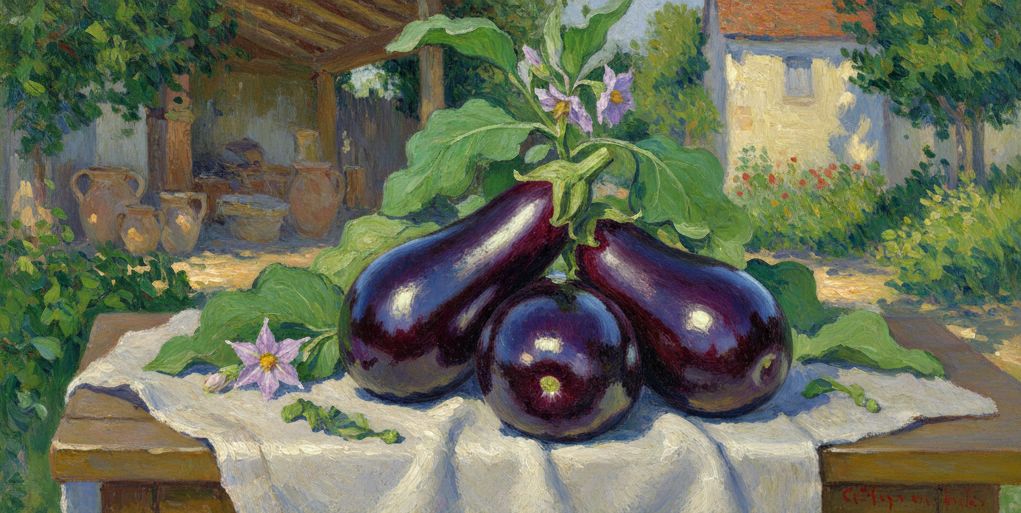
COMMON EGGPLANT (Solanum melongena L.)
The nightshade family – Solanaceae
I. BOTANICAL DESCRIPTION AND BIOLOGICAL CHARACTERISTICS
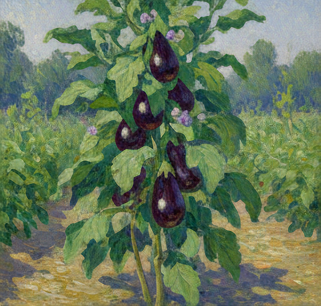
Morphology: Annual herbaceous plant. Stem 25–130 cm tall, branched, with thorns, green with purple stripes or dark purple. Leaves are large, oval-ovoid, pubescent. Flowers are large, purple, solitary or 3–5 per inflorescence.
Fruit: Multi-seeded berry weighing from 50 to 3000 g. Seeds remain viable for 3–4 years.
Environmental requirements: Heat-loving plant; optimal temperature for growth is 22–24°C. At temperatures below 15°C, the flowers fall off. Demanding in terms of soil moisture.
II. PHYTOCHEMICAL COMPOSITION (per 100 g of product)
Eggplant (Solanum melongena) is characterized by a significant concentration of mineral elements, notably: boron (143.0% of the Daily Value [DV] per 100 g), silicon (97.0%), lithium (68.0%), and rubidium (26.0%). The carbohydrate profile includes glucose (20.0% DV) and starch (0.2–0.9 g per 100 g), while sucrose is absent from its composition.
It is noteworthy that eggplant cultivars with dark-purple exocarps contain substantial levels of the carotenoid lutein (averaging 15.5% DV per 100 g, with peak concentrations reaching 30.0%). This xanthophyll accumulates in ocular tissues, providing essential photoprotection and supporting visual acuity. Conversely, in light-colored (white) varieties, lutein is below detectable limits.
The total purine base content per 100 g constitutes approximately 7.0% of the daily allowance, while the total phytosterol content represents 12.7% DV.
The concentration of oxalic acid per 100 g is 18 mg, representing 4.5% of the maximum tolerable daily intake (for further details, see Rhubarb).
The pharmacological value of eggplant is primarily attributed to delphinidin glycosides—anthocyanin pigments possessing potent antioxidant activity. These glycosides are localized in the peel and are responsible for the dark-purple pigmentation; they are absent in white varieties. The predominant anthocyanin is nasunin (delphinidin 3-[4-(p-coumaroyl)-L-rhamnosyl (1→6) glucopyranoside]-5-glucopyranoside). Nasunin exhibits significant antioxidant properties and exerts an inhibitory effect on angiogenesis (the proliferation of new vascular structures), a biological process critical to the progression of various pathologies, most notably oncology.
Calories per 100 g: 22.6 kcal
Water in 100 g: 91.0 g
Ash in 100 g: 0.5 g
CHEMICAL COMPOSITION
Vitamins, macro- and microelements, nutrients per 100 g
VITAMINS
| Name | Content, mass fraction per 100 g of product | % of daily value | |
|---|---|---|---|
| in figures | visually* | ||
| Vitamin B1 (thiamine) | 0.04 mg | 2.7% |  |
| Vitamin B2 (riboflavin) | 0.05 mg | 3.0% | |
| Vitamin B5 (pantothenic acid) | 0.22 mg | 4.4% | |
| Vitamin B6 (pyridoxine) | 0.15-0.20 mg | 8.5% |  |
| Vitamin B9 (folic acid) | 18.5-27.0 mcg | 6.0% | |
| Vitamin B12 (cyanocobalamin) | 0.0 mcg | 0.0% |  |
| Vitamin C (ascorbic acid) | 2.2-5.0 mg | 3.5% | |
| Vitamin E (alpha-tocopherol) | 0.03 mg | 0.2% | |
| Gamma-tocopherol | 0.2 mg | 1.3% | |
| Vitamin D (ergocalciferol) | 0.0 mcg | 0.0% | |
| Vitamin PP (nicotinic acid) | 0.65-0.8 mg | 4.0% | |
| Vitamin K (phylloquinone) | 3.5 mcg | 2.9% | |
| Biotin | 0.0 mcg | 0.0% | |
| Beta-carotene | 16.0-20.0 mcg | 0.36% | |
| Lycopene | 14.0 mcg | 0.3% | |
| Lutein | 0.0 mcg (light fruits) 65.0-1800.0 mcg (dark fruits) |
0.0% (light fruits) 15.5% (dark fruits) |
(світлі плоди)  (темні плоди) (темні плоди) |
| Zeaxanthin | 5.0-16.0 mcg | 0.4% | |
| Beta-cryptoxanthin | 0.0 mcg | 0.0% | |
| Choline | 6.9 mg | 1.0% | |
*Full jug – 100% daily value; empty – 0–1% daily value.
MINERAL ELEMENTS
Macroelements
| Name | Content, mass fraction per 100 g of product | % of daily value | |
|---|---|---|---|
| in figures | visually | ||
| Potassium | 238.0-240.0 mg | 10.0% | |
| Calcium | 9.0-15.0 mg | 2.3% | |
| Silicon | 29 mg | 97% |  |
| Magnesium | 9.0-14.0 mg | 3.7% | |
| Sodium | 2.0-6.0 mg | 0.4% | |
| Sulfur | 15.0 mg | 1.5% | |
| Phosphorus | 25.0-34.0 mg | 3.9% | |
| Chlorine | 47.0 mg | 2% | |
Microelements
| Name | Content, mass fraction per 100 g of product | % of daily value | |
|---|---|---|---|
| in figures | visually | ||
| Aluminum | 815.0 mcg | 2.3% | |
| Boron | 100 mcg | 142.9% |  |
| Vanadium | 1.7 mcg | 4.2% | |
| Iron | 0.24-0.4 mg | 1.7% | |
| Iodine | 2 mcg | 1.0% | |
| Cobalt | 1.0 mcg | 10% | |
| Lithium | 68 mcg | 68% |  |
| Manganese | 210.0-250.0 mcg | 12.2% | |
| Copper | 80.0-140.0 mcg | 12% | |
| Molybdenum | 10.0 mcg | 14% | |
| Nickel | 0.395 mcg | 0.26% | |
| Rubidium | 26.0 mcg | 26% |  |
| Selenium | 0.3 mcg | 1.1% | |
| Fluorine | 14.0 mcg | 0.2% | |
| Chromium | 0.7 mcg | 1.4% | |
| Zinc | 160.0-290.0 mcg | 1.4% | |
PROTEINS AND AMINO ACIDS
| Name | Content, mass fraction per 100 g of product | % of daily value | |
|---|---|---|---|
| in figures | visually | ||
| Total protein content | 1.2 g | 2.0% | |
| Essential amino acids content | 0.4 g | 1.8% | |
| Non-essential amino acids content | 0.72 g | 1.3% | |
Essential amino acids
| Acid name | Content, g per 100 g of product | % of daily value | |
|---|---|---|---|
| in figures | visually | ||
| Valine | 0.05-0.07 | 2.4% | |
| Histidine | 0.02-0.03 | 2.5% | |
| Isoleucine | 0.05-0.06 | 3.5% | |
| Leucine | 0.05-0.06 | 2.5% | |
| Lysine | 0.05-0.06 | 1.6% | |
| Methionine | 0.01 | 0.3% | |
| Threonine | 0.04-0.05 | 3.0% | |
| Tryptophan | 0.01 | 1.5% | |
| Phenylalanine | 0.04-0.06 | 1.1% | |
Non-essential amino acids
| Acid name | Content, g per 100 g of product | % of daily value | |
|---|---|---|---|
| in figures | visually | ||
| Alanine | 0.05-0.07 | 1.0% | |
| Arginine | 0.06 | 0.98% | |
| Aspartic acid | 0.16-0.17 | 1.4% | |
| Glycine | 0.04-0.05 | 1.4% | |
| Glutamic acid | 0.186-0.200 | 1.4% | |
| Proline | 0.04-0.06 | 1.1% | |
| Serine | 0.04-0.05 | 0.6% | |
| Tyrosine | 0.03-0.05 | 1.0% | |
| Cystine | 0.01 | 0.7% | |
FATS AND FATTY ACIDS
| Name | Content, mass fraction per 100 g of product | % of daily value | |
|---|---|---|---|
| in figures | visually | ||
| Total fat content | 0.19 g | 0.19% | |
| Unsaturated fatty acids content | 0.092 g | 0.22% | |
| Omega-3 unsaturated fatty acids content | 0.01 g | 1% | |
| Omega-6 unsaturated fatty acids content | 0.06 g | 0.6% | |
| Saturated fatty acids content | 0.034 g | 0.2% | |
Unsaturated fatty acids
| Acid name | Content, g per 100 g of product |
|---|---|
| Palmitoleic C 16:1 (omega-7) | 0.0 g |
| Oleic C 18:1 (omega-9) | 0.01 g |
| Linoleic C 18:2 (omega-6) | 0.06 g |
| Linolenic C 18:3 (omega-3) | 0.01 g |
| Stearidonic C 18:4 (omega-3) | 0.0 g |
| Gadoleic C 20:1 (omega-11) | 0.0 g |
| Arachidonic C 20:4 (omega-6) | 0.0 g |
| Eicosapentaenoic C 20:5 (omega-3) | 0.0 g |
| Erucic C 22:1 (omega-9) | 0.0 g |
| Clupanodonic C 22:5 (omega-3) | 0.0 g |
| Docosahexaenoic C 22:6 (omega-3) | 0.0 g |
| Nervonic C 24:1 (omega-9) | No data |
Saturated fatty acids
| Acid name | Content, g per 100 g of product |
|---|---|
| Myristic C 14:0 | 0.0 g |
| Palmitic C 16:0 | 0.03 g |
| Stearic C 18:0 | 0.01 g |
| Arachidic C 20:0 | No data |
| Behenic C 22:0 | No data |
| Lignoceric C 24:0 | No data |
Sterols
| Name | Content, mass fraction per 100 g of product | % of daily value | |
|---|---|---|---|
| in figures | visually | ||
| Sum of phytosterols | 7.0 mg | 12.7% | |
| Cholesterol | 0.0 mg | 0% | – |
CARBOHYDRATES
| Name | Content, mass fraction per 100 g of product | % of daily value | |
|---|---|---|---|
| in figures | visually | ||
| Total carbohydrate content | 5.7-7.0 g | 1.7% | |
| Mono- and disaccharides | 3.6 g | 7.2% | |
| Glucose | 1.4-3.0 g | 20% | |
| Fructose | 0.8-1.4 g | 2.9% | |
| Sucrose | 0.0 g | – | – |
| Starch | 0.2-0.9 g | – | – |
| Fiber | 2.5-3.4 g | 15.8% | |
| Pectin | 0.4 g | 8.0% | |
PURINE BASES
| Name | Content, mass fraction per 100 g of product | % of daily value | |
|---|---|---|---|
| in figures | visually | ||
| Sum of purines content | 8 mg | 6.7% | |
OXALIC ACID
| Name | Content, mass fraction per 100 g of product | % of daily value | |
|---|---|---|---|
| in figures | visually | ||
| Oxalic acid content | 18.0 mg | 4.5% | |
TOTAL POLYPHENOL CONTENT
| Name | Content, mg per 100 g of product |
|---|---|
| Sum of polyphenols | 46.8-182.9 |
PHENOLIC ACIDS
| Acid name | Content, mcg per 100 g of product |
|---|---|
| Hydroxycinnamic acids | |
| Caffeic | 710-713 |
| p-Coumaric | 64-148 |
| Ferulic | 160-355 |
| Hydroxybenzoic acids | |
| Gallic | 268-423 |
| Protocatechuic | 705-2236 |
| p-Hydroxybenzoic | 73-141 |
FLAVONOIDS
| Name | Content, mcg per 100 g of product |
|---|---|
| Nasunin | 63063.1 |
| Delphinidin-3-rutinoside-5-glucoside | 328.8 |
| Delphinidin-3-rutinoglucoside | 170.7 |
| Delphinidin-3-glucoside | 148.6 |
| Delphinidin-3-rutinoside | 3405.4 |
Units of measurement:
Piece: about 130.0 g
Tea glass (cup): 250.0 g
Faceted glass: 200.0 g
Teaspoon: 7.0 g
Tablespoon: 20.0 g