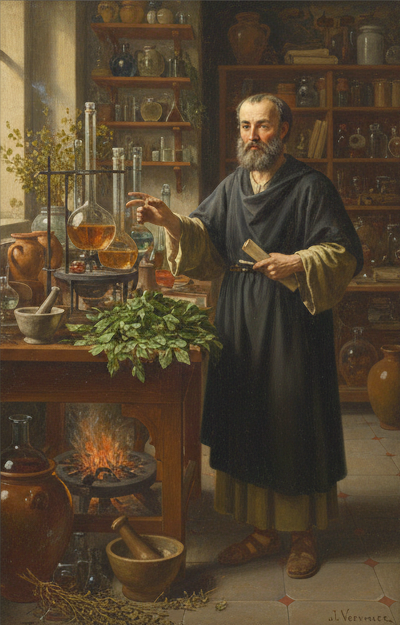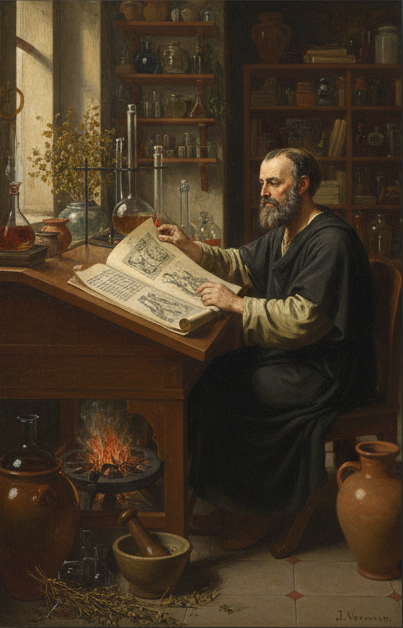
Galen Claudius

Claudius Galen (131–201 AD). 70 years

      Ancient Roman physician, philosopher, naturalist.

    Born in Pergamum, the son of the architect Nikon. After thorough and comprehensive study of philosophy with representatives of the four main schools of that time: Stoic, Platonic, Peripatetic, and Epicurean, Galen began studying the art of medicine at the age of 17, training with various renowned physicians in his hometown, Smyrna, and Corinth. To expand his knowledge, he undertook a journey to Lycia and Palestine, after which he lived for a long time in Alexandria, the center of the scholarly world of that time, to improve himself primarily in anatomy.

     Galen’s journey to Alexandria greatly broadened the scope of his knowledge and interests. He eagerly observed and studied all the sciences that interested him. Galen knew all the Greek dialects, as well as Latin, Ethiopian, and Persian languages. He spent more than 6 years traveling, and when he returned to Pergamum, he became a physician in the gladiatorial school, where he practiced surgery for 4 years. In 164, the 33-year-old scholar moved to Rome and soon became popular there as an educated lecturer and experienced physician; he was known to the emperor and philosopher Marcus Aurelius, and became close to the Peripatetic Eudemus, a well-known philosopher in Rome whom he cured and who praised him as the most skilled physician.

    Even after becoming a popular physician and treating patients from the Roman nobility, Galen did not refuse to help the impoverished sick. The Roman patrician Boethius, along with Galen’s friends, insisted on the establishment of a course of lectures on anatomy, and Galen delivered them in the Temple of Peace for a large audience of citizens interested in science and representatives of medicine. In his lectures, Galen demonstrated dissections of various animals.

    At the same time, he experienced a severe shock – the loss of his manuscripts, which were burned in a fire at the Temple of Peace. In Rome, Galen wrote many works, including his main anatomical-physiological treatise “De usu partium corporis humani” – “On the Function of the Parts of the Human Body”.    

    Galen wrote no less than 300 works, primarily on medical, as well as philosophical, mathematical, and legal subjects. About 80 of his medical works have survived to this day. They concern anatomy, physiology, pathology, pharmacology, therapy, hygiene, dietetics, obstetrics, and embryology. He highly valued the significance of plants as medicinal agents and initiated the production of extraction preparations, widely known as Galenic preparations.

     Galen’s aphorism: “The physician is a helper of nature.”

Similar Posts

  • Theophrastus

    Theophrastus: “If you are uneducated and silent, you behave wisely; if you are educated and silent, you are foolish”. Theophrastus (also known as Pheophrastus or Tirtamos, or Tirtam) (372–287 BC). 85 years        An ancient Greek philosopher, naturalist, music theorist, and one of the most famous botanists of antiquity, he is often referred to…

  • Grapefruit: A Danger for Women?

    Grapefruit – a danger for women? Estrogens and breast cancer? Weight loss?     Several years ago, results obtained by American scientists from the University of Southern California and the Cancer Research Center of Hawaii (Monroe K.R., Murphy S.P., Kolonel L.N., Pike M.C. (2007)) shocked the scientific community. In a study of the health status of…

  • Quince

    QUINCE      The fruits of the quince (Cydonia oblonga) possess a high concentration of ascorbic acid (21.0% of the Daily Value [DV] per 100 g) and choline (vitamin B4) (17.0%). The mineral profile is characterized by a significant concentration of multiple elements: boron (249.0% DV per 100 g), rubidium (55.0%), vanadium (50.0%), chromium (39.0%),…

  • Mykola Valiashko

    “Science without practice is dead, and practice without science is blind and dangerous.” Mykola Ovksentiyovych Valiashko (March 20, 1871 – January 25, 1955). 84 years Mykola Valiashko is a seminal figure who effectively transformed Ukrainian pharmacy from a craft-based “herbalism” into a fundamental academic science. As the first rector of the Kharkiv Pharmaceutical Institute, he…

  • Parenchyma tissues. Chlorenchyma: Botanical Comics

    And once again, at the beginning of our humorous botanical comic in the series of preparation for the licensing exam in pharmaceutical botany – a new humorous poem in the style of Pavlo Glazovyi! Chlorenchyma: “The Solar Manufactory” Now, let us pay tribute to chlorenchyma – a specialized form of the ground tissue (parenchyma), the…

  • Barley

    BARLEY (PEARL BARLEY) Barley and the pearl barley obtained from it (whole cleaned and polished barley grains) are a rich source of vitamins, various mineral elements, amino acids, phytosterols, starch, and fiber. Thus, barley is rich in vitamin B1 (thiamine) (28.8% of the daily norm per 100 g), vitamin PP (nicotinic acid) (25.8%), biotin (22.0%),…