How to Remember the Formulas of Xanthones
we do not ask for leniency.
How to remember the formulas of xanthones?
If flavonoids have the structure C6C3(with a heteroatom O)–C6, where a ketogroup is often located opposite the heteroatom, then true xanthones are practically the same, but C6C3(with a heteroatom O)C6 (the ketogroup remains).
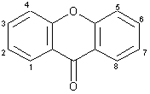
Structure of true xanthones
From true xanthones, you should know the formula of mangiferin. This is a glycoside, whose aglycone is a xanthone containing 5 –OH groups (only one C8 position remains free). When forming mangiferin, one –OH group is glycosylated (at the C2 position). As the name suggests, mangiferin was first isolated from mango (in Latin Mangifera indica), and it is also found in St. John’s wort and alpine pennyroyal.
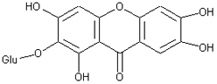
Mangiferin
It is not difficult to guess that in the formation of furanoxanthones, in addition to the xanthone structure C6C3C6, a furanose ring is also involved (let’s remember fructose!), and in the formation of pyranoxanthones – a pyranose ring (the base of glucose).
The furanose ring attaches to the xanthone base “at the foot” to the upper part of the benzene ring, and the first resembles a fish, where the oxygen atom appears as a “head,” opposite which is a “tail” formed by two –CH3 groups.
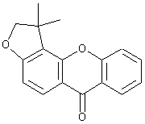
Structure of furanoxanthones
Pyranoxanthones are represented by linear, angular, and dipyranoxanthones.
In linear pyranoxanthones, the pyranose ring attaches linearly, in angular ones (from English angular – angle) – at an angle (to the lower part of the benzene ring), and in dipyranoxanthones, there are two pyranose rings that can be attached in both ways.

Structure of linear Structure of angular Structure
of pyranoxanthones of pyranoxanthones dipyranoxanthones