How to Remember Vitamin Formulas
it is useful to doubt.
Of course, the plants that are vitamin carriers most often recalled are those that contain ascorbic acid (= vitamin C).
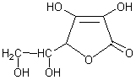
Ascorbic acid (= Vitamin C)
The formula of ascorbic acid resembles the golden fleece as it is depicted in books about the Argonauts: the heterocyclic oxygen atom plays the role of the “head,” while the hydroxyl groups are the “hind legs.” Regarding the “front legs,” on the left is the golden fleece, evidently chained to something by a chain of two carbon atoms, each link (carbon atoms) also branched (carrying an -OH group). The “right front leg,” apparently, was also once chained, and now it is injured and bandaged (=O group).
Of course, the structure of ascorbic acid shown in the illustration is not the only possible form of the molecule: it has 15 tautomers, but only 5 of them are biologically active; among them is the isomer you see in the illustration.
Carotenoids are tetraterpenes in their structure.
The molecule of beta-carotene is based on two subunits connected “tail to tail.” The “head” in these subunits is represented by the beta-ionone ring, that is, a cyclohexane ring which has one double bond on the right side and “antennae” on the “head” (two methyl groups, which we, as previously agreed, do not label, but draw only as dashes – “antennae”).
The “tail skeleton” consists of 9 carbon atoms connected by a system of double bonds (every other one, – thus, each subunit has 4 double bonds, and when the subunits are connected, there is one more, meaning the entire beta-carotene molecule in the “tail part” has 9 double bonds arranged alternately).
The “tail” is usually depicted as a braid, in which there is a “spike” every other “tooth” (presumably, so that it is convenient for roosters on the braid…).

beta-Carotene
Thus, it is evident that you should start drawing the formula of beta-carotene from the “head” with “antennae.” Note that, in addition to the “tail,” there is also one “leg” (–CH3 group from the lower right carbon atom) extending from the “head,” meaning after the “head,” draw the “leg,” and then the “tail” (arranging the 9 carbon atoms as a “braid,” adding the system of double bonds and “spikes”). Now, you just need to create a mirror image of the obtained subunit, and the formula is ready.
By the way, if you have developed spatial imagination, you can envision this molecule as a large two-headed caterpillar that has been cut into two parts, with the lower part attached to the upper part not as it is done in nature, but by the cut ends – thus forming the beta-carotene molecule.
The molecule of vitamin K1 (= phylloquinone) can, like beta-carotene, be divided into “head” and “tail.”
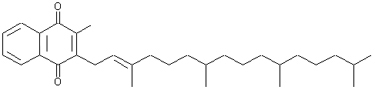
The “main part” consists of two benzene rings, the first of which has no substituents (one could say that these are the “jaws” of a gluttonous caterpillar), while the second contains “eyes” – two =O groups – and a “leg,” which, unlike the beta-carotene molecule, is located above, over the “tail.”
The “tail skeleton” consists of 16 carbon atoms, which, like in beta-carotene, are also arranged as a “braid,” but this “braid” has no “spikes” on top, no double bonds along the “braid” itself (there is one double bond at the beginning of the formation of the “braid”), and has only 4 “supports” (branching of the main chain formed by the addition of –CH3 groups).