How to memorize the formulas of thioglycosides

Rule sixteen –
     let’s start competing!

           How to remember the formulas of thioglycosides?

   You have one last section of pharmacognosy to consider, and it is not the most difficult one. Gather yourself – the finale is near!
    Thioglycosides – compounds that contain sulfur – are a complex of substances from the mustard plant Brassica juncea Czern., black mustard Brassica nigra (L.) Koch., and some other plants from the Brassicaceae family.
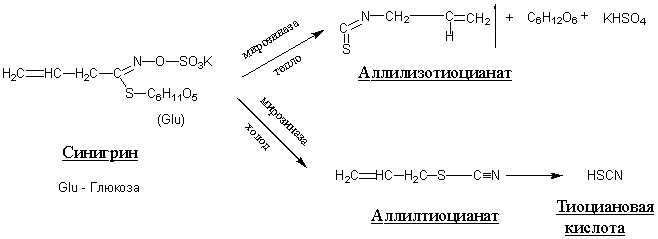
  Sinigrin is a thioglycoside of mustard that, under the action of the enzyme myrosinase, decomposes into allyl thiocyanate or allyl isothiocyanate depending on external conditions.
  You can easily remember the formula of sinigrin if you learn that at the beginning of the molecule it has 3 carbon atoms, which are only bonded to hydrogen, followed by a carbon from which branches extend: the upper branch: =N–O–SO3K (read in Russian – “nosok”), and the lower one: –S–C6H11O5 (Glu = glucose, meaning sinigrin is a glycoside).
tioglikozidy

In an aqueous environment at a temperature of 50–60оC, the enzyme myrosinase, which specifically cleaves sinigrin, converts it into allyl isothiocyanate, the formula of which starts with S=C=N–. This is a volatile component of mustard essential oil. It is allyl isothiocyanate that penetrates through the pores into our body when we use mustard plasters, and it is this compound that exerts antibiotic action.
  When stored in the cold, myrosinase cleaves sinigrin into allyl thiocyanate (did you guess that this is an isomer of allyl isothiocyanate?), which has the same molecular formula as allyl isothiocyanate but differs from it in the position of the S=C=N– group. In allyl thiocyanate, –S–C=N completes the formula. Allyl thiocyanate is a non-volatile component and cannot easily penetrate through human skin pores.

  What should we take away from all of the above? The action of mustard plasters is due to allyl isothiocyanate and some other isothiocyanates. When stored, sinigrin, which is the source of allyl isothiocyanate, decomposes into allyl thiocyanate, which does not exert the necessary antibiotic action, so it is important to consider the shelf life of mustard plasters when using them.

Similar Posts

  • Avocado

    AVOCADO         The fruits of the avocado (Persea americana) possess an exceptional concentration of silicon (213.0% of the Daily Value [DV] per 100 g), boron (143.0%), nickel (140.0%), potassium (20.0%), copper (19.0%), rubidium (17.3%), molybdenum (14.0%), manganese (11.0%), magnesium (10.1%), cobalt (10.0%), and iron (9.8%). The vitamin profile includes pantothenic acid (19.0%),…

  • Vanadium for Plants: Photosynthesis Rate

             Vanadium (V)          For the plant – the rate of photosynthesis.              In the plant organism vanadium is part of porphyrins and hemoproteins. A positive role of vanadium in the fixation of atmospheric nitrogen by microorganisms, in lipid metabolism, and in photosynthesis has been established.  …

  • Black currant

    BLACK CURRANT      The fruits of the black currant (Ribes nigrum) possess an exceptional concentration of vitamins, particularly ascorbic acid (263.0% of the Daily Value [DV] per 100 g) and tocopherols (vitamin E). Among the tocopherol isomers, the concentrations of delta-tocopherol (28.3%), gamma-tocopherol (26.9%), and alpha-tocopherol (13.7%) are notably high. The vitamin profile also includes…

  • Dogwood

    DOGWOOD (CORNEL)        Dogwood fruits (Cornus mas) are characterized by an exceptional concentration of ascorbic acid (88.6% of the Daily Value [DV] per 100 g) and contain a significant concentration of folate (folic acid) (12.5%). The mineral profile includes a substantial fraction of macro- and microelements: boron (85.1% DV per 100 g), rubidium…

  • Viburnum

    VIBURNUM (fruit)         Viburnum berries (Viburnum opulus) possess a high concentration of vitamins, specifically ascorbic acid (119.0% of the Daily Value [DV] per 100 g), vitamin K (phylloquinone) (83.0%), beta-carotene (38.0%), and vitamin E (alpha-tocopherol) (13.0%). The mineral profile is characterized by a significant concentration of macro-, micro-, and ultramicroelements: boron (457.0%…

  • Root Structure: Botanical Comics

    The Underground Secrets of Radix Panasovich and little Radyk Cast off all doubts and boredom! Today, our scientific expedition shifts its vector: we are diving where the sun doesn’t shine, but life teems – straight into the depths of the soil! Instead of railway tracks, we are blazing a trail through xylem and phloem.Our steadfast…