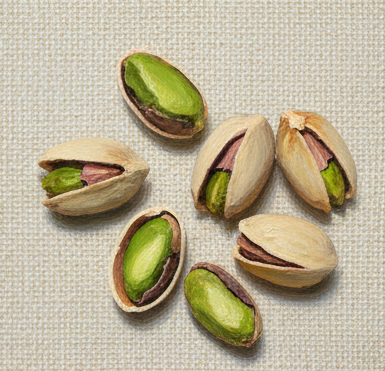
Nuts and Seeds

Nuts and seeds are valuable for humans primarily due to their high content of proteins, a significant portion of which consists of essential amino acids, and fats – sources of polyunsaturated fatty acids and fat-soluble vitamins, especially vitamin E and B vitamins. The significant fat content naturally accounts for their high caloric value – 600-700 kcal per 100 g of raw material, which exceeds the energy value of bread by 3-3.5 times, meat by 4-6 times, and vegetables, fruits, and berries by 10-15 times.
Due to the presence of polyunsaturated fatty acids (especially those belonging to the omega-3 family), as well as monounsaturated oleic acid and tocopherols, the consumption of nuts and seeds is a good preventive measure against atherosclerosis and cardiovascular diseases.
Interestingly, the ratio of omega-3 to omega-6 polyunsaturated fatty acids in nuts and seeds is close to that in breast milk, and this ratio is considered optimal (omega-3/omega-6 = 1:4-6, see also: Omega–3 or omega–6: which is better?).
This has allowed the World Health Organization to recommend “for children over six months who are not breastfed, nut pastes … as good sources of essential fatty acids” (for example, paste from dried peanut seeds or from sesame = sesame).
For an adult, the optimal amount of nuts and seeds per day is a dose of 30 g. It should be noted that the human body cannot absorb more than 100 g of nuts at one time.
As with other food products, the data on the content of essential nutrients in nuts and seeds is presented based on raw mass, that is, in their original form.
However, some nuts must be subjected to thermal or other processing before consumption.
For example, in almonds, there is up to 3-5% cyanogenic glycoside amygdalin, the breakdown products of which give the nut its bitterness and characteristic almond smell. This is related to the fact that almond seeds contain the enzyme emulsin, under the influence of which amygdalin is broken down, releasing cyanide – one of the strongest poisons. Therefore, consuming bitter almonds in raw form is unsafe for health. During the thermal processing of almonds, emulsin is destroyed, and amygdalin, which remains unchanged, does not pose a danger to the human body.
Raw peanuts cause digestive disorders and are often a cause of food allergies. This is due to the fact that lectin proteins in raw peanut seeds are specific to lymphoblast receptors in the spleen and disrupt hematopoiesis (specifically, they cause the formation of T and B lymphocytes).
The mechanism of food allergy to peanut proteins is briefly as follows. In food allergies, T and B lymphocytes produce specific proteins – immunoglobulin E, which interact with food proteins. When immunoglobulin E interacts with an allergen, biologically active substances are released that affect various organs – the gastrointestinal tract, skin, respiratory tract. As a result, characteristic allergy symptoms occur: nausea, vomiting, diarrhea, rash, itching, swelling, malaise, weakness, and in severe cases – respiratory distress. That is, a reaction occurs that is similar to the body’s response to the entry of pathogenic microorganisms, but mistakenly directed at the proteins of certain products, in this case – at the proteins of peanuts. With the participation of immunoglobulin E, an immediate reaction to the allergen occurs, meaning symptoms develop very quickly, and the situation can become life-threatening. At the same time, under thermal exposure (above 50oC), the lectin proteins of peanut seeds are destroyed (their structure is disrupted), so when consuming roasted or dried peanut seeds, the corresponding immunoglobulins and lymphoblasts are not formed, and food allergy does not occur.
Raw unpeeled cashews are also not used, as caustic substances – phenylisoprenoids anacardic acid and cardol – are present between the shell and the nut’s skin. Upon contact with the skin, they cause hyperemia up to significant burns. Therefore, before industrial use, cashew nuts are extracted from their shells and skins with extreme caution and subjected to special thermal processing, during which toxic phenylisoprenoids are destroyed.