The Animated Lab: Visualizing Phytochemical Analysis
Welcome to our PharmaNova Visual Lab!🧪✨
Step into a unique educational space where complex science meets digital art. Here, every phytochemical reaction animation is designed to provide you with the perfect visual reference for your laboratory studies.
If you’re tired of textbooks where ‘a cherry-red precipitate’ exists only on paper, while in the actual lab it ends up looking like ‘toddler’s surprise’ (or doesn’t appear at all) – you’ve come to the right place!
We believe that seeing one perfect animation is better than ten attempts at scrubbing a test tube after a failed experiment. Here, we’ve gathered the ‘crème de la crème’ of chemical and histochemical transformations: from the elegant dance of tannins reacting with ferric ammonium sulfate to the passionate histochemical hues that will ensure you never mistake a root for a rhizome during your professional exams.
Watch, memorize, and please – don’t try this at home (especially without a fume hood, a lab coat, and a cap)!🔬🧬
Step into a unique educational space where complex science meets digital art. Here, every phytochemical reaction animation is designed to provide you with the perfect visual reference for your laboratory studies.
If you’re tired of textbooks where ‘a cherry-red precipitate’ exists only on paper, while in the actual lab it ends up looking like ‘toddler’s surprise’ (or doesn’t appear at all) – you’ve come to the right place!
We believe that seeing one perfect animation is better than ten attempts at scrubbing a test tube after a failed experiment. Here, we’ve gathered the ‘crème de la crème’ of chemical and histochemical transformations: from the elegant dance of tannins reacting with ferric ammonium sulfate to the passionate histochemical hues that will ensure you never mistake a root for a rhizome during your professional exams.
Watch, memorize, and please – don’t try this at home (especially without a fume hood, a lab coat, and a cap)!🔬🧬
Science is the pursuit of Truth, and poetry is the language of the Soul. Here, we unite the two to explore the rigid laws of chemical transformation through the rhythmic lens of a literary classic.
Commencing ‘Poetic Histochemistry’ (In the Style of Rudyard Kipling)
Object and Reagent |
Animated Micro-preparation |
Poetic Commandment (The Student’s Cheat Sheet) |
|---|---|---|
|
Inulin in Alcohol (Precipitation of Spherocrystals)
|
 Technical Note (when ethanol is added to sections containing inulin, the substance precipitates as characteristic spherocrystals, which can be clearly observed under a microscope)
|
The Law of the Spherocrystal
If you can pour the Spirit, cold and steady, Upon the slice where Inulin remains, And keep your weary eyes and senses ready To watch the spheres emerge from liquid planes; If you can see the crystal globes appearing, Like tiny stars within a glass-bound night, Not grains, not dust – but spheres, their edges clearing, To prove the starch-less sugar’s hidden might; Then by this Sign, the test is won, my brother, The Alcohol has set the phantom free: ’Tis Inulin – and not some simple other – Pure Spherocrystals for the world to see! |
|
Inulin Identification (Molisch’s Test with α-naphthol)
|
 Technical Note (Molisch’s test is a sensitive chemical check for the presence of carbohydrates. When α-naphthol and concentrated sulfuric acid are applied to the inulin-containing section, the acid hydrolyzes the polysaccharide into monosaccharides, which then dehydrate to form furfurals. These compounds condense with α-naphthol, producing a characteristic violet or purple coloration)
|
The Law of the Royal Violet
If you can take the Naphthol’s crystal trace, And touch the section with a drop of Fire, To watch the Acid run its burning race, And fulfill every chemist’s deep desire; If you can wait until the shadows break, And see the Inulin begin to glow, Not with the red that common pigments make, But with the Purple only Kings should know; If every cell within your narrow sight Turns violet beneath the morning sun, Then you have brought the hidden truth to light – The Molisch Test is passed! The Work is done! |
|
Detection of Mucilage (Reaction with Methylene Blue)
|
 Technical Note (Methylene blue is a cationic dye that selectively binds to the acidic polysaccharides found in mucilage. As the reagent penetrates the cells, the mucilage absorbs the pigment, swelling slightly and turning a distinct sky-blue color, which allows for precise localization of the substance within the plant tissues)
|
The Law of the Azure Veil
If you can take the Blue of summer skies, And drop it where the silent juices sleep, To watch the azure stain begin to rise, And into every hidden corner creep; If you can see the clear and glassy swell Turn deep and sapphire as the moments fly, To mark the boundaries of every cell Against the empty void that wanders by; If what was lost and pale as morning mist Now wears the uniform of Royal Blue, Then Science gives your hand a sudden twist – The Mucilage is caught! The Sign is true! |
|
Mucilage Visualization (Negative Staining with Indian Ink)
|
 Technical Note (In this contrast method, Indian ink serves as a dark background that cannot penetrate the mucilage due to the latter’s high molecular weight and colloidal nature. As the mucilage particles swell, they push the carbon suspension aside, appearing as bright, pearly-white masses (clumps) against a stark, jet-black field. This provides exceptional clarity for observing the morphology of mucilage-containing cells)
|
The Law of the Bright Eclipse
If you can shroud the world in deepest coal, To hide the secrets of the grain and wood, And let the ink, like midnight, take its toll As only ancient chemist’s shadows should; If through that dark, a sudden pearl appears, Not stained by soot, but ghostly, clean, and bright, To rise above your academic fears Like winter snow within the dead of night; If white and black in perfect battle meet, And clear-cut globes within the ink you see, Then is your triumph total and complete – The Mucilage is found! So let it be! |
|
Detection of Starch (Reaction with Lugol’s Iodine Solution)
|
 Technical Note (Lugol’s solution (aqueous iodine and potassium iodide) acts as a specific indicator for starch. The iodine molecules (I3–) slide into the interior of the amylose helix, forming a polyiodide complex. This physical entrapment alters the light absorption of the molecule, resulting in the characteristic deep blue or blue-black coloration. Amylopectin, due to its branched structure, would give a more reddish-violet hue)
|
The Law of the Indigo Spiral
If you can take the Amber of the Sun, Which men call Lugol’s dark and golden tea, And let its weary, creeping liquid run To find the starch where’er its grains may be; If you can watch the Amber turn to Night, A sudden surge of Indigo and Ink, To hide the silver starch from morning light And pull the senses to the very brink; If deep within the helix, dark and coiled, The Iodine finds its eternal rest, Then let the lab-coat stay – though somewhat soiled – The Amylose is blue! You’ve passed the test! |
|
Detection of Fixed Oils and Suberin (Reaction with Sudan III)
|
 Technical Note (Sudan III is a lysochrome (fat-soluble dye) used for the histochemical determination of lipids. The staining mechanism is based on the physical solubility of the dye: it leaves the solvent (alcohol) to dissolve more readily in the droplets of fixed oils or the waxy matrix of suberin. This results in a bright orange or reddish-orange coloration of oil bodies and cork cell walls)
|
The Law of the Amber Glow
If you can take the Sudan’s crimson grain, Dissolved in spirits, clear and sharp and cold, And pour it where the hidden fats remain, To turn the silent cell to burnished gold; If you can see the corky walls ignite, Or oily droplets take a sudden flame, To glow with Orange, vivid, warm, and bright, And put the pale and ghostly cells to shame; If Suberin stands guard in robes of Fire, Or Fixed Oils shine like embers in the pan, Then you have reached the goal of your desire – The Test is won! You’ve found the Fats, my man! |
|
Sublimation of Anthraquinones (Formation of yellow needle-shaped crystals)
|
 Technical Note (Sublimation is a key diagnostic technique for identifying anthracene derivatives (such as those found in Rhubarb or Buckthorn bark). Upon controlled heating, the free anthraquinones vaporize and then condense on a cool surface (the cover slip). This physical process yields pure, characteristic golden-yellow needle-like crystals, which can be further confirmed by the Bornträger reaction (turning red with the addition of alkali))
|
The Law of the Golden Needle
If you can apply the Flame with steady hand, To drive the spirit from the woody crust, And watch the vapors rise at your command, Escaping from the dry and ancient dust; If you can catch the breath upon the glass, And keep the surface level, smooth, and cold, To see the fleeting, ghostly shadows pass, And crystallize in needles of the gold; If yellow spears, as sharp as winter’s frost, Arise from heat to greet your weary eye, Then not a single moment has been lost – The Anthraquinones live! They do not die! |
|
Detection of Alkaloids (Reaction with Dragendorff’s Reagent)
|
 Technical Note (Dragendorff’s reagent (potassium bismuth iodide) is a classic precipitating agent for alkaloids. The reaction involves the formation of a complex salt where the alkaloid cation interacts with the tetraiodobismuthate anion [BiI4]–. This results in the formation of amorphous precipitates or, more characteristically, bright orange or reddish-orange needle-shaped crystals)
|
The Law of the Orange Briar
If you can call the Bismuth to your aid, Within a drop of Iodide, dark and red, To find the Alkaloid that seeks the shade, And wake the crystals from their liquid bed; If through the lens a sudden forest grows, Of orange needles, sharp and etched in fire, As if a tiny, copper-tinted rose Had shed its thorns to sate your soul’s desire; If what was hidden now stands bold and clear, In jagged lines of sunset’s burning hue, Then cast away the shadow of your fear – The Dragendorff is right! The Work is true! |
Analysis Chronicles. The Language of Colors: Dialogues with Active Molecules
Subsection: Pharmacognosy
On the Trail of Secondary Metabolites: The Phyto-Detective
(Qualitative Reactions in the Style of Robert Burns and George Gordon Byron)
Object and Reagent |
Reaction Mechanism (Chemistry) |
Animated Qualitative Reaction |
Poetic Commandment
(The Student’s Cheat Sheet) |
|---|---|---|---|
|
Coumarins (The Lactone Test, reversible lactone ring opening)
|

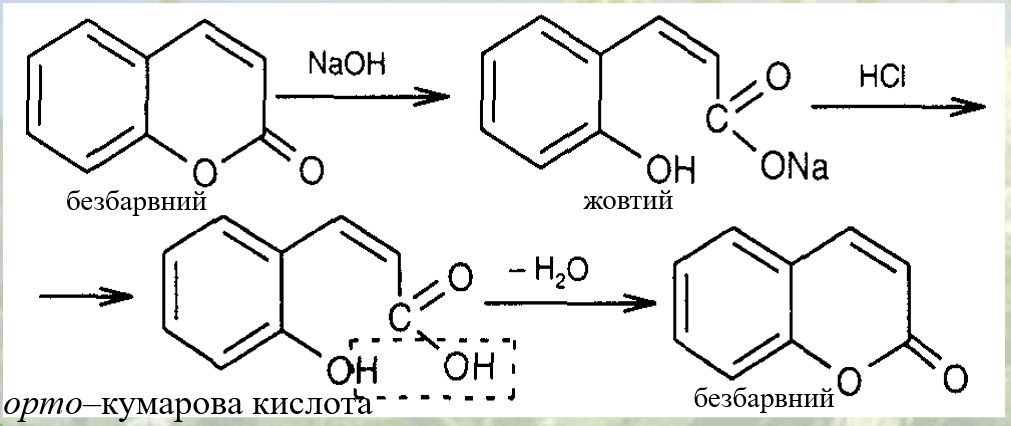
Step 1: Under the action of an alkali, the alpha-pyrone (lactone) ring undergoes reversible opening to form salts of o-coumaric (o-hydroxycinnamic) acid, which results in a distinct yellow coloration of the solution.
Step 2: Upon acidification, the lactone ring closes (re-cyclization), returning the molecule to its original state, which leads to the decolorization of the solution. Key Diagnostic Difference: This reversible behavior distinguishes coumarins from chromones. While the alpha-pyrone ring of coumarins re-cyclizes, the gamma-pyrone ring of chromones undergoes irreversible opening under alkaline conditions, typically producing a stable red color. |
  |
The Tale of the Vanished Ring (In the Style of Robert Burns)
My heart’s in the Highlands, my heart isna here, But let us bring Coumarin and Alkali near! When spirits of Potash are poured in the glass, A strange, silent magic begins then to pass: The ring, like a circle of true lover’s gold, Must open its secret, so shy and so bold; The color departs like the mist on the brae, And clear as a burn flows the liquid away! But bring back the Acid! The spirit returns, As sure as the heather in summertime burns; The lactone is closed, and the truth is restored, Like a wanderer home to the land he adored! |
|
Condensed and Hydrolyzable Tannins (Differential Identification: Iron (III) and Bromine Tests)
|
Reaction Mechanism (General Principles)

Upper Block of the Painting: Reaction with Iron (III) Chloride or Ferric Ammonium Sulfate
Condensed Tannins (Pyrocatechol group): Form complex salts with a characteristic black-green coloration. Hydrolyzable Tannins (Pyrogallol group): Form complex salts with a characteristic black-blue coloration. Lower Block of the Painting: Reaction with Bromine Water
Condensed Tannins: Undergo electrophilic substitution and further polymerization, resulting in the formation of a white precipitate. Hydrolyzable Tannins: Do not react with bromine water under these conditions (reaction is absent). |
 Chemical Mechanism of Tannin Reactions (Detailed Analysis)I. Reaction of Tannins with Iron (III) Chloride Hydrolyzable Tannins (Pyrogallol group):
The Fe3+ ion coordinates with the oxygen atoms of the phenolic hydroxyl groups. Due to the presence of three adjacent (vicinal) OH-groups, highly stable inner-complex (chelate) compounds are formed. The high density of these binding sites throughout the molecule leads to the formation of an intensely colored solution, manifesting as a characteristic dark black-blue color: 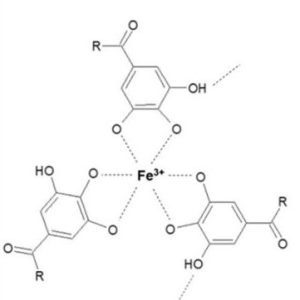 Condensed Tannins (Pyrocatechol group):
In this case, a chelate complex is also formed; however, the molecular structure of condensed tannins is more rigid and bulky. The interaction of Fe3+ with ortho-diphenolic groups (two adjacent OH-groups) results in a different electronic absorption spectrum, which is perceived visually as a black-green tint. Over time, these complexes tend to precipitate due to the progressive aggregation and polymerization of the molecules: 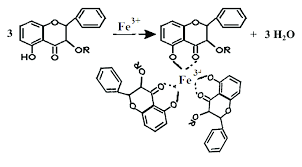 II. Reaction of Tannins with Bromine Water 1. Condensed Tannins (Detection and Differentiation):
The reaction of condensed tannins with bromine water leads to the formation of a precipitate, which is a classic qualitative test for their differentiation from hydrolyzable tannins. Activation: Condensed tannins often consist of flavan-3-ol units (e.g., catechin). The phenolic hydroxyl groups (–OH) strongly activate the aromatic rings (specifically Ring A), increasing the electron density at the ortho– and para-positions. Substitution: Bromine molecules (Br2) attack the available reactive centers in the aromatic rings (most frequently at positions 6 and 8 of Ring A). Hydrogen atoms are substituted by bromine atoms. Solubility: The introduction of heavy bromine atoms (atomic mass ~80) drastically reduces the water solubility of the polymer. Additionally, bromine may facilitate further oxidative polymerization and cross-linking of tannin molecules. Result: The formation of a yellowish-white amorphous precipitate consisting of polybromo-derivatives. No reaction occurs between bromine water and hydrolyzable tannins 2. Hydrolyzable Tannins (Absence of Reaction):
Hydrolyzable tannins are esters consisting of gallic or ellagic acid residues conjugated with glucose. These acids are already “overloaded” with carbonyl and hydroxyl groups, which deactivate the aromatic ring compared to catechins. Upon interaction with bromine water, hydrolyzable tannins may form bromo-substituted compounds, but they typically remain water-soluble. They are not prone to the rapid oxidative polymerization characteristic of the flavonoid structures that constitute condensed tannins. |
Poetic Verdict (The Bard’s Comparison)
I. The Iron’s Choice (The Color Duel) The Forest’s Dark Secret (Condensed – Green) The Catechin, like Deep Green Moss that grows Where Byron’s dark and rocky river flows; With Iron met, it wears the Forest’s Hue, A Black-Green shadow, ancient, cold, and true. The Highland Night (Hydrolyzable – Blue) But Burns sings of the Blue-Black midnight air, Like Scottish lochs when stars are shining there; The Pyrogallol takes the Ink-Blue dye, As deep and dark as Scotland’s evening sky. II. The Bromine’s Verdict (The Solubility Test) The Winter’s Trap (Condensed – White Precipitate) When Bromine falls like Winter’s sudden snow, The Catechin has nowhere left to go; A White Opaque descends upon the glass, And will not let the light of science pass. The Ghostly Guest (Hydrolyzable – No Reaction) But for the Gallic acid, clear and bright, The Bromine is a ghost within the night; No snow is seen, no solid forms its trace, It leaves the water with a Clear, calm face. |
|
Flavonoids (The Cyanidin Test / Shinoda Test)

Reagents: Concentrated Hydrochloric Acid (HCl) and Magnesium (Mg) powder. |
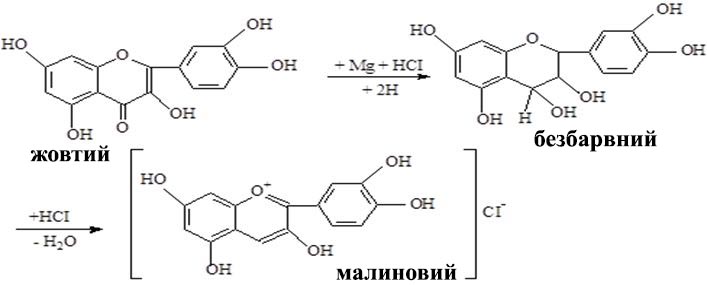
Mechanism of the Cyanidin Test (Shinoda Modification)
Mechanism: The Cyanidin test is a specific qualitative reaction for the identification of flavonoids, frequently performed using the Shinoda modification. The Process of Reduction: Flavonoids undergo reduction by nascent hydrogen ([H]), which is generated in situ through the reaction of metallic magnesium with concentrated hydrochloric acid (HCl). Chemical Transformation: This reduction proceeds via the formation of intermediate, colorless leucoanthocyanidins, which are subsequently converted into stable, colored anthocyanidins (pyrylium salts). Visual Identification: Flavonols specifically yield a characteristic coloration ranging from crimson to bright red. The Bryant Modification (Phase Partitioning)
Mechanism: The Bryant modification is utilized following a positive Cyanidin test to differentiate between flavonoid glycosides and their aglycones. Procedure: A non-polar solvent (such as octanol or n-butanol) is added to the reaction mixture. The solution separates into two distinct phases: an upper organic layer and a lower aqueous layer. Interpretation of Results: Organic Layer Coloration (Upper): If the color migrates into the octanol or butanol phase, the raw material contains only aglycones (which are lipophilic). Aqueous Layer Coloration (Lower): If the color remains in the aqueous phase, only glycosides (which are hydrophilic) are present. Both Layers Colored: The presence of both layers being colored indicates that the raw material contains flavonoids in both glycosidic and aglycone forms. |
  |
Part 1. The Crimson Awakening (Lord Byron Style)
Within the leaf, a secret lies concealed, By common light of day is ne’er revealed; But touch it with the Acid’s burning breath, And wake the metal from its silver death! Behold! The Magian powder starts to glow, As hidden fires in the vessel grow; Through ghostly shades of Leuco-forms it flies, To flash its Crimson truth before our eyes! Part 2. The Great Divide (Lord Byron Style) Two spirits in one crimson veil unite, But oil and water shall reveal the light; The Aglycone, like a wanderer bold, Seeks in the Upper Layer its home of gold. The Glycoside, to mother water bound, Stays in the Depths where its true soul is found; But if both realms with royal red are dyed – The plant holds both, in scientific pride! |
Subsection: Pharmaceutical Chemistry:
“Analytical Symphony: The Logic of Colour and Structure”
(Qualitative Reactions by Rudyard Kipling)
Object and Reagent |
Reaction Mechanism (Chemistry) |
Animated Qualitative Reaction |
Poetic Commandment
(The Student’s Cheat Sheet) |
|---|---|---|---|
|
The Vitali-Morin Reaction for Tropane Alkaloids
|

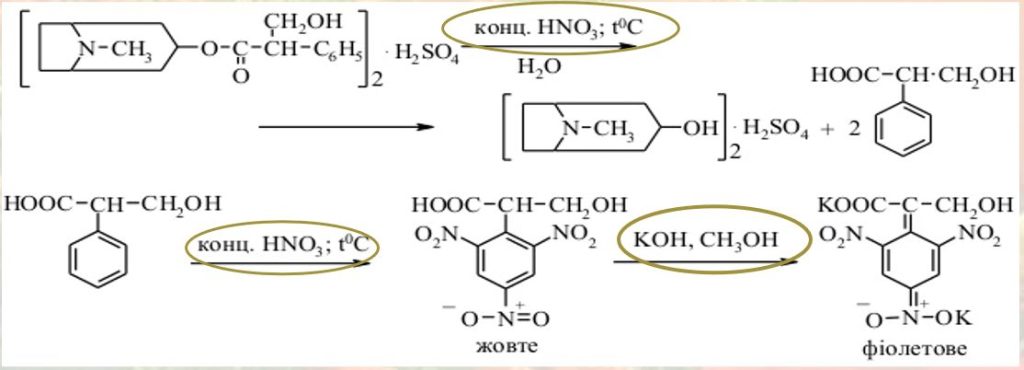
Chemical Process: The reaction is a specific identification test for alkaloids containing the tropic acid moiety (such as atropine and scopolamine).
Nitration Stage: Treatment with concentrated (fuming) nitric acid (HNO3) followed by evaporation to dryness leads to the nitration of the benzene ring. This results in the formation of a yellow polynitro compound. Color Development Stage: Upon the addition of a 0.5M alcoholic solution of potassium hydroxide (KOH) and acetone to the dry residue, a nucleophilic interaction occurs. Complex Formation: This leads to the formation of a highly conjugated quinoid complex (specifically a Janovsky-type complex), which manifests as an intense violet coloration. Kinetic Note: The resulting violet color is unstable and gradually disappears upon standing as the complex undergoes further transformation or degradation in the alkaline medium. |
  |
The Law of the Purple Shadow (The Kipling Style)
First the Acid, fierce and fuming, bites the ring with yellow fire, Till the residue is dried and parched upon the furnace-pyre; Then the Potash and the Spirit bring the Violet to the light – A royal flash of purple law that shatters out the night! But mark the Law: the shadow fades, the colour will not stay, Like a phantom of the jungle, it shall softly slip away. If the Purple lived a moment, then the Tropane test is true – Now clear the glass, and start the task, and build the Law anew! |
|
The Thalleioquin Test for Quinoline Alkaloids
|

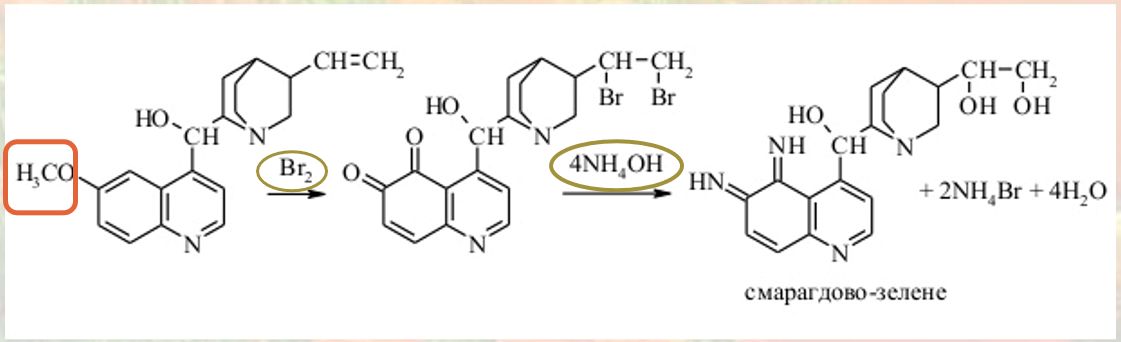
Chemical Process: The thalleioquin test is a diagnostic oxidation reaction used to identify quinine and quinidine.
Oxidation Stage: The interaction with bromine water (Br2) oxidizes the quinine molecule, leading to the formation of an ortho-quinone intermediate. Condensation Stage: Subsequent treatment with a dilute ammonia solution (NH3) facilitates the formation of diimino-derivatives characterized by an ortho-quinoid structure. Structural Specificity: The reaction results in a distinct emerald-green coloration. Diagnostic Rule: This test is highly specific. Other cinchona alkaloids that lack a methoxyl group (–OCH3) in their molecular structure do not yield this reaction.
|
  |
The Emerald Seal (The Kipling Style)
The Bromine bites the Quinine ring to wake the Ortho-form, Like a lightning flash that rips the sky before a jungle storm; Then the Ammonia brings the word to set the Spirit free – And turns the pale and bitter draught to Emerald, like the sea! But hear the Law of Cinchona, as old as hill and track: If the Methoxy is missing, then the Green shall not come back! The common bark may plead its case and claim a royal name, But only true and ancient blood can kindle up that flame! |
|
The Murexide Test for Purine Alkaloids
|

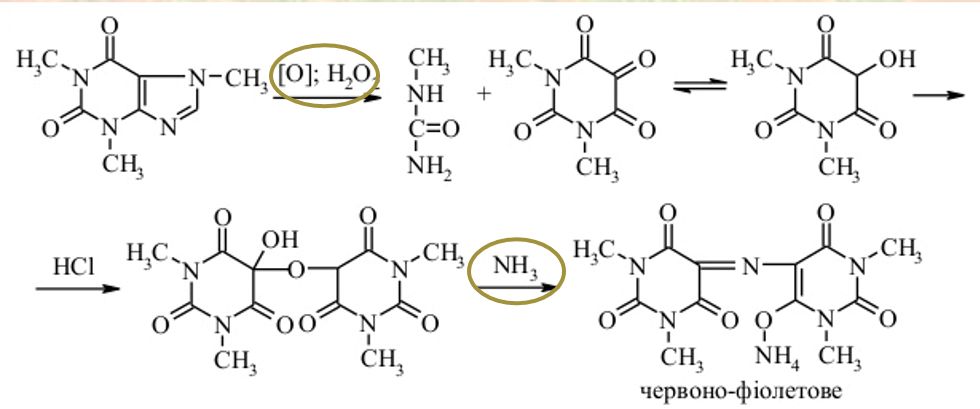
Chemical Process: The murexide test is a group identification reaction for purine derivatives (such as caffeine, theobromine, and theophylline).
Oxidative Degradation: The reaction is based on the destruction of the purine nucleus upon heating with an oxidizing agent (hydrogen peroxide, bromine water, nitric acid, etc.). This leads to the formation of a mixture of methylated derivatives of alloxan and dialuric acid. Condensation Stage: These intermediates interact with each other to form methylated derivatives of alloxantin. Color Development: Upon treatment with an excess of ammonia solution (NH3), a characteristic red-violet coloration appears. Result: The coloration is due to the formation of the ammonium salt of tetramethylpurpuric acid, commonly known as murexide. |
  |
The Rite of the Crimson Salt (The Kipling Style)
Through the Fire and the Acid, through the Alloxan in the heat, The Purine yields its spirit till the cycle is complete; White and silent in the vessel, parched and dry beneath the flame, Till the Spirit of Ammonia comes to call it by its name! Then the Purple wakes in glory, like a banner in the sun, To tell the Master-Analyst that the heavy work is done. By the Coffee and the Tea-leaf, by the Law that cannot fail – The Murexide shall answer: “I have told the hidden tale”! |
🎭 Epilogue: When the Test Tube Knows More than Google
Step by step, we have journeyed from the poetic patterns within the plant cell to the rigorous logic of the pharmaceutical symphony. Remember: if your life ever lacks a splash of color, just add the right reagent!
The most important thing is not to confuse the “Phyto-Detective” with making coffee in the lab. A true pharmacist knows: a quality reaction is when the color is perfect, the precipitate is convincing, and the starting compound surrenders without a fight.
May your analytical chronicles always end with a “happy ending,” and may the only “unknown substances” in your life be those that confidently turn the right color on the very first try.
Stay tuned – there is much more to come, for science, much like a gripping detective story, never rests on its laurels!
Step by step, we have journeyed from the poetic patterns within the plant cell to the rigorous logic of the pharmaceutical symphony. Remember: if your life ever lacks a splash of color, just add the right reagent!
The most important thing is not to confuse the “Phyto-Detective” with making coffee in the lab. A true pharmacist knows: a quality reaction is when the color is perfect, the precipitate is convincing, and the starting compound surrenders without a fight.
May your analytical chronicles always end with a “happy ending,” and may the only “unknown substances” in your life be those that confidently turn the right color on the very first try.
Stay tuned – there is much more to come, for science, much like a gripping detective story, never rests on its laurels!