How to remember the formulas of alkaloids 2
First, we will focus on two compounds that belong to the group of protoalkaloids. They do not have a nitrogen atom in the rings, but contain it in their side chains.
Ephedrine is a benzene ring with a branched chain consisting of four atoms of the main link and two branches. Nitrogen in the form of an –NH– group is part of the main chain. The protoalkaloid ephedrine is found in the herb of plants of the genus Ephedra (Ephedra sp., Ephedraceae).
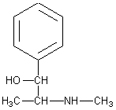
Ephedrine
Colchamine – the protoalkaloid of colchicine – has a rather complex structure. It consists of three interconnected rings of varying degrees of saturation: one 6-membered and two 7-membered.
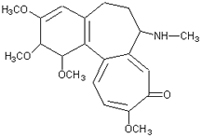
Colchamine
It is easier to draw it by starting the drawing with an “eight” – two interconnected 7-membered rings, and then add a 6-membered ring to the upper one from the left.
The colchamine molecule has four –OCH3 groups, three of which branch off from the 6-membered ring, and the fourth from the lowest position of the “eight.” Nitrogen in the form of an –NH– group is located in a two-membered chain that branches off from the upper part of the “eight” and ends with a –CH3 group.
Colchamine, along with other alkaloids of the colchicine group, is found in the tubers of species of the genus Colchicum (Colchicum sp., Liliaceae).
Among the true alkaloids, you should learn 13 compounds (indeed: a complex number – complex material).
The derivative of pyrrolizidine is platyphyllin. Besides the pyrrolizidine skeleton, it contains an acid residue, meaning that platyphyllin is a complex ester.
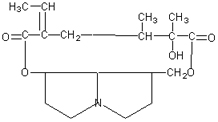
Platyphyllin
The structure of platyphyllin can be compared to “beaver teeth” – incisors as strong as those of a beaver. They are anchored on “gums,” the lower part of which on the right side rests on –CH2O– (apparently, hollow), and on the left – on –O– (intact); the upper part of the “gums” branches out on both sides with a “pair of nerves” (=O groups); the “gums” themselves consist of six carbon atoms, one of which is free, and from the others, bonds branch off: from the edge (as already mentioned) – =O, from those closer to the edge – on the left side =CH–CH3, on the right – –OH and –CH3, and further on the left, the atom remains free, while on the right from it, a –CH3 group branches off. Thus, the innervation of our “beaver” is quite good: we assume that the “nerves” branch off to the “ears” (two edge =O), and to the eyes (on the left =CH–CH3, on the right –OH and –CH3), and to the nose (one –CH3 group).
Platyphyllin is found in the rhizomes and herb of the flat-leaved ragwort Senecio platyphylloides Somm. et Lev. (Asteraceae); it got its name from the species name of the plant.
The derivatives of tropane include hyoscyamine and scopolamine. They are very similar in structure, but scopolamine additionally contains a heterocyclic (with an oxygen atom) three-membered ring.

Hyoscyamine Scopolamine
Hyoscyamine is formed by the addition of an acid residue to the tropane molecule, meaning it, like platyphyllin, is a complex ester. This residue contains a benzyl radical (the benzene ring C6H5) and, in addition, a chain –COO–CH(CH2OH) –.
It is commonly found in the leaves of black henbane (Hyoscyamus niger L., Solanaceae), from which it gets its name.
When forming scopolamine, a tricyclic lactone ring is added to the left part of hyoscyamine. The resulting structure looks very much like a sharpened pencil.
The word “scopolamine” comes from the name of the plant in the rhizome of which this alkaloid was discovered – Scopolia carniolica (Scopolia carniolica Jacq., Solanaceae).
Among the derivatives of quinolizidine, we will consider pachycarpine and cytisine.
In their construction, two (in pachycarpine) or one (in cytisine) cyclohexane rings are additionally added to the quinolizidine molecule, which has two cyclohexane rings (remember, “Chin in Liza …”).
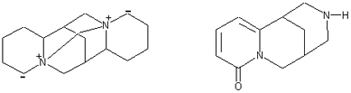
Pachycarpine Cytisine
Pachycarpine is a polar molecule. As we can see from its structure, the nitrogen atoms in it are tetravalent, which cannot be the case if the molecule is neutral. Thus, the nitrogen atoms carry a positive charge, while the neighboring carbon atoms carry a negative charge.
Pachycarpine is the main alkaloid of the herb of the thick-fruited sophora Sophora pachycarpa C.a. Mey (Fabaceae). Its name comes from the Latin species name of the plant.
Cytisine is an alkaloid of the lanceolate thermopsis Thermopsis lanceolata R.Br. (Fabaceae), although it got its name from another plant of the legume family, in the seeds of which it is found in large quantities (up to 3%) – the common laburnum Cytisus laburnum L.
When forming cytisine, one 6-membered heterocycle containing a nitrogen atom condenses with the quinolizidine molecule (thus, cytisine has 2 nitrogen atoms in its molecule). In addition, cytisine is a quinone, meaning that one of its quinolizidine rings is unsaturated, and a carbonyl group is attached to it.
Among the derivatives of isoquinoline, we will consider papaverine, morphine, codeine, and glaucine.
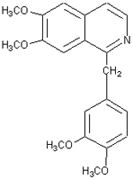
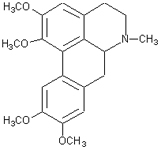
Papaverine Glaucine
The first three alkaloids are found in the capsules of the opium poppy Papaver somniferum L. (Papaveraceae) – hence the name papaverine; glaucine is found in the herb of the yellow horned poppy Glaucium flavum Crantz (Papaveraceae).
Papaverine belongs to the benzylisoquinoline alkaloids, as in its molecule, a benzene ring is attached to the main isoquinoline cycle. The other listed alkaloids are phenanthreneisoquinoline, as their structure is based on two molecules – phenanthrene (phenanthrene has 3 benzene rings, just like anthracene, but in the molecule of anthracene, the benzene rings are connected linearly, while in the molecule of phenanthrene, two are linear and one is angular, i.e., at an angle) and isoquinoline.
To construct the papaverine molecule, we add a benzene ring to the isoquinoline molecule through a –CH2 group to the lower carbon atom of the nitrogen-containing cycle (in the position adjacent to the nitrogen atom). In addition, the papaverine molecule contains 4 –OCH3 groups – two in each benzene ring. The formula of papaverine as depicted in your drawing resembles a headless robot mechanically stepping forward with outstretched arms (the –OCH3 groups play the role of limbs).
The molecule of glaucine, in terms of the arrangement of –OCH3 groups, somewhat resembles the molecule of papaverine, but the nature of the bonds between the rings in the former is slightly different. In glaucine, we already have 4 rings: two benzene rings, one fully saturated 6-membered heterocyclic ring with a nitrogen atom, and one cyclohexane ring. The heterocyclic ring in glaucine becomes saturated by the addition of a methyl group to the nitrogen.
If, however, in the molecule of glaucine, we break the heterocyclic ring at the upper position of its attachment to the benzene ring and conduct an intramolecular condensation with the cyclohexane ring, linking the benzene rings with the help of a new heterocycle – a 3-membered lactone – and also completely remove the lowest –OCH3 group, while adding –OH instead of the uppermost one, then such a molecule will be called codeine.
Continuing further modifications, we change the last –OCH3 group to –OH, and we obtain morphine.
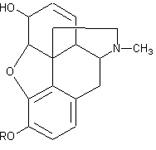
R = H – Morphine
But the most complex formula among all the alkaloids we are discussing has the indole derivative – the alkaloid strychnine, isolated from the seeds of the Strychnos nux vomica L. (Loganiaceae).
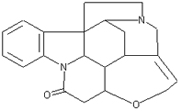
Strychnine
To make it a bit easier for you to study, memorize it in parts. First, draw the indole formula, then add a cyclohexane ring near the heterocyclic ring. From this ring, build another heterocyclic ring – as if it were a mirror image of the first heterocycle (as if, because you can construct the upper part like a house or a garage, whichever is easier for you to visualize). Now make a “roof” over the “house” from the heteroatom nitrogen to the “wall of the house,” which it is attached to the indole. We have dealt with the upper part of the formula.
Next, we will add another 6-membered ring to the heterocycle of the indole molecule – it is heterocyclic because it has a nitrogen atom shared with indole. Near the next carbon atom with nitrogen, we attach a =O group, and symmetrically to it, we start to build a structure from another heterocyclic ring – this time with an oxygen atom, that is, we attach –O–, which we cyclize with two more carbon atoms, and connect them to the farthest point of the “foundation of the house.” This forms a 7-membered lactone ring (which is also, by the way, unsaturated at the point of attachment to the “foundation”).
If you gradually build this complex structure step by step, it will no longer seem so frightening to you as at first glance.
You haven’t forgotten that we were discussing strychnine, have you? The appearance of its molecule can indeed be intimidating. But nothing will scare a true student, right?
We will also be interested in three purine derivatives – theophylline, caffeine, and theobromine.
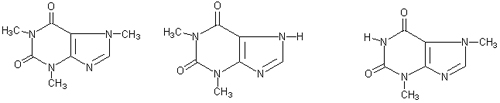
Caffeine Theophylline Theobromine
The first of them is isolated from the leaves of tea Thea sinensis L. (Theaceae), although it is present in trace amounts; caffeine, as you may have guessed, is from coffee seeds Coffea arabica L. (Rubiaceae), where its content varies from 0.65 to 2.7% depending on the variety (and in tea leaves, by the way, it is 1.5–3.5%!); theobromine is from cocoa seeds Theobroma cacao L. (Sterculiaceae), where its content ranges from 0.4 to 1%.
As we already know, the purine molecule contains 4 nitrogen atoms.
We will begin examining the formulas of these three compounds, apparently, with caffeine, which has all atoms, except for the lower nitrogen in the 5-membered ring and the adjacent free carbon, substituted. Three nitrogen atoms in caffeine are attached to –CH3 groups, and two carbon atoms have carbonyl groups (=O) attached.
To build theophylline from caffeine, we remove the –CH3 group from the nitrogen of the 5-membered ring, replacing it with hydrogen.
If we remove the –CH3 group from another location, namely from the nitrogen located between the =O groups in the 6-membered ring, we obtain theobromine.
This sequence is quite easy to remember by recalling your daily routine: in the morning we drink coffee (caffeine), in the afternoon – tea (theophylline), and in the evening – cocoa (theobromine).
And finally, among the pseudoalkaloids, we will focus on the steroid alkaloid solasodine. It is found in the herb of the cut-leaved nightshade Solanum laciniatum Ait. (Solanaceae) and is mainly used for the production of the steroid hormone progesterone, which is an important product in the synthesis of cortisone.
Solasodine is essentially a steroid saponin–monodesmoside of diosgenin (remember, don’t be lazy!), but instead of an oxygen atom at position C27, it contains a nitrogen atom.
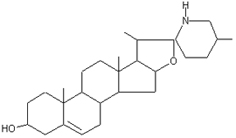
Solasodine
You can breathe a sigh of relief! You have overcome the alkaloids. Now just two more small steps, and the pharmacognosy exam will not seem scary at all.